For agencies capped by hours
SEO automation
The repetitive SEO work, done at scale
SEO automation takes the repeat SEO jobs off your team and runs them as systems. The hardest part is setting it up. Once it's built it runs by itself, and I check the output at the end. Timing is agreed when I scope the job.
I research every page before writing, then a dedicated set of blocking rules stop anything that reads like generic AI output.
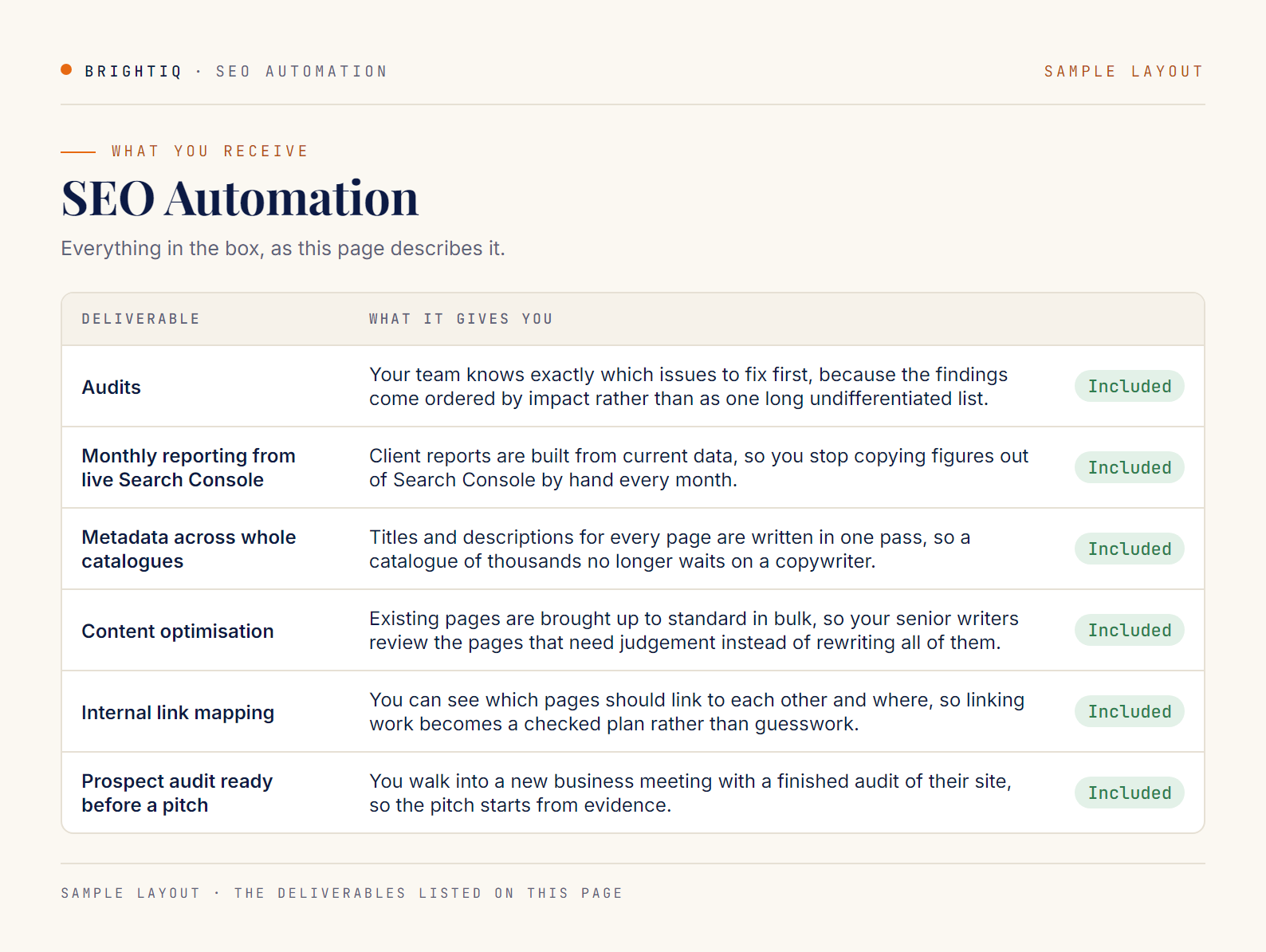
An SEO Automation is a bespoke system that takes the repetitive layer of SEO delivery off an agency's team, producing audits, monthly reporting pulled from live Search Console data, analytics, metadata across whole catalogues, content optimisation, internal link maps, AI visibility checks and prospect audits ready before a pitch. Each system is built around one agency's workflow and branded to that agency.
How BrightIQ works for agencies
How BrightIQ works with an agency: start with one service and a free sample on a client you know, research before writing, bad output stopped before it ships, your brand on every piece and your team sees it first, delivered on a set date.
Is your agency's growth capped by the hours you can find?
Most agencies hit the same ceiling: growth is capped by hours. Each new client brings more work than the team can absorb, so the only way to take on more business is to add more people to do it.
Every new client adds the same repetitive work: the audit, the monthly report, the metadata pass. Each one is needed, and none of it needs a senior person's judgment. The only lever anyone has is hiring, so the workload grows with every client added.
So margin goes to headcount, and senior people spend their week on work that does not need them. SEO Automation takes the repeat layer, the audit, the report and the metadata pass, so that time goes back to the work only they can do.
Pick the outputs your team needs
You confirm the scope first, then the system produces each output and hands it over owned outright.
What do you need to provide?
You give me access to your inputs, and I confirm the scope before any build starts.
How is the system shaped?
I build the system around your agency's workflow, with no template or plugin in between.
What lands on your desk?
The system produces audits, monthly reports, analytics, metadata, content optimisation, link maps and AI visibility checks.
Can you show a prospect their gaps first?
I prepare a prospect audit before your pitch, so the first conversation starts with findings.
One system, built for your workflow
The confirmed scope and the outputs it produces are handed over and owned by you, with your team still making the calls.
What you get
Six outputs your team receives, each one removing a piece of work that currently falls to your people.
Audits covering technical health, metadata, content, internal links and AI visibility
You know which fixes come first for each client, so account leads stop guessing what to recommend.
Monthly reporting pulled from live Search Console
Each client report carries that month's real figures, so you stop rebuilding slides from exports at the end of every month.
Metadata across whole catalogues
A store with thousands of product pages gets its titles and descriptions finished in one pass, not a queue that holds the account back for weeks.
Internal link mapping
You can see which pages pass authority to which, and where a link is missing, before a client asks why a page is not ranking.
AI visibility checks
You can tell a client whether their brand appears in AI answers, rather than guessing at a channel they already ask about.
Prospect audit ready before a pitch
You walk into the first call with the prospect's gaps already measured, so the conversation starts with findings rather than a generic capability deck.
A report you can send without rewriting it
The monthly report opens on live Search Console figures, with that month's biggest changes set out first. You can read it in minutes and send it under your own name.
The system does the counting. Deciding which movement matters, and what to tell the client about it, stays with your account lead.
Audits, metadata across whole catalogues, content optimisation and internal link mapping, with timing agreed when I scope the job.
What changes after SEO automation?
Your timeline is scoped per engagement, so the schedule is agreed in writing before any build starts.
Scope and access are confirmed, and the outputs your team needs are listed in writing.
I build the system around your workflow and test it against your own data until each output matches how your team operates.
The system and its outputs pass to your team in full, and you run them yourselves from that point on.
Once handed over, your account leads spend their week on client judgment instead of rebuilding the same audit and report by hand.
How is this different from hiring another SEO?
| Hiring another SEO | SEO Automation | |
|---|---|---|
| Capacity | Grows one hire at a time | Grows with systems that run the repeatable work |
| Margin | Goes to headcount | Priced per deliverable, so the margin stays with you |
| Senior people | Spend the week on work that does not need them | Freed for the work that does |
| Pitches | Wait while nobody has time for the audit | A prospect audit ready before the pitch |
Content at scale that is information dense instead of AI slop, because research runs before the writing and a gate runs after it.
Three ways to work together
One deliverable
A single audit, metadata run or content pass, priced from the production menu and timed when I scope it.
Fulfilment Plans
A monthly plan of audits, reports and content for your clients, delivered on a set date.
The Agency Plug-in
Any job sent as a URL and a brief, back under your brand with a work order.
Why trust me with this?
I'm Sebastian Beaton, and I built the audit engine myself after 17 years in SEO. Across about 25 runs on roughly 20 client sites, March to July 2026, one person built and ran every step, so nothing went to a junior. I don't do web design, paid ads, social media or team replacement.
Client reports are built from current data, so you stop copying figures out of Search Console by hand every month, as my automated SEO reports do.
Who built this
Every system, every pipeline, every deliverable, built and maintained by one person.

Credentials
Experience
It is designed specifically to be information dense and to avoid the AI slop trap. That is the whole point: research runs before any writing, and a validation gate sits after it, so what ships is dense with real information rather than padded with the generic phrasing a model reaches for by default.
Why this matters
- ✓ Research before writing, and the run will not start without it. Live search results, the questions people actually ask, and the top competing pages are read first.
- ✓ A validation gate after it. A page is blocked if it copies the product feed, invents a review count or rating, states a price, or links nowhere.
- ✓ A blocked page goes to a human. It does not silently retry until something passes.
Frequently asked questions
How do you make sure I only fix what matters?
I rank every fix by the pages and queries carrying real traffic, so your account lead sees the highest-value work first. Low-impact items stay listed but sit below the fixes that change results.
Can I start with just one output, such as metadata across my catalogue?
Yes. Outputs are chosen per agency, so you can begin with metadata across a whole catalogue and add audits or reporting later. I'd rather you start small with one workflow that proves its value than commit to the full system on day one.
Is this right for my agency?
It is right if you run enough client accounts that senior people are the bottleneck and each new client adds repeat work. If one person still handles everything comfortably, the time saving will be modest, and I'd say so on the call.
How do you know the audits hold up on large sites?
On the largest full-site crawl I have run, 1,040 of 1,061 pages were crawled, which is 98%. Coverage like that matters because a fix list built from a partial crawl can miss the pages that matter most.
Can I see a sample before I commit?
Yes. Request a white-label sample audit and I will run it on a site you choose, so you can judge the output before committing to a build. The sample shows the format and depth your clients would receive, so the decision rests on evidence rather than a sales deck.
What makes the metadata different from pasting my product feed into an AI?
Pasting a feed gives you fluent words, not content, since the model knows nothing beyond the manufacturer's copy that every competitor uses. My output carries information the page does not already have, so it can earn a click.
Related services
Find out whether it fits your agency
Get in touch and I will tell you plainly whether this suits your agency, and what the first conversation covers, before you commit to anything.
- Book a callSend your details and I reply within one working day.
- Scope agreedI confirm what you get and the delivery date before any work starts.
- DeliveredSEO Automation is delivered on the date agreed with you.