For agencies and store developers
The BrightIQ Technical SEO Audit
Every infrastructure issue
A technical SEO audit service gives your developer the list: crawl and indexation problems, orphan pages and redirect chains, each with the fix. I don't tell anyone to ignore a finding. I rank them, because a best practice only counts once the bigger problems are sorted. Back in 48 to 72 hours.
I built this for developers and technical leads who want a list of what's broken and nothing else, with fixes they can action directly.
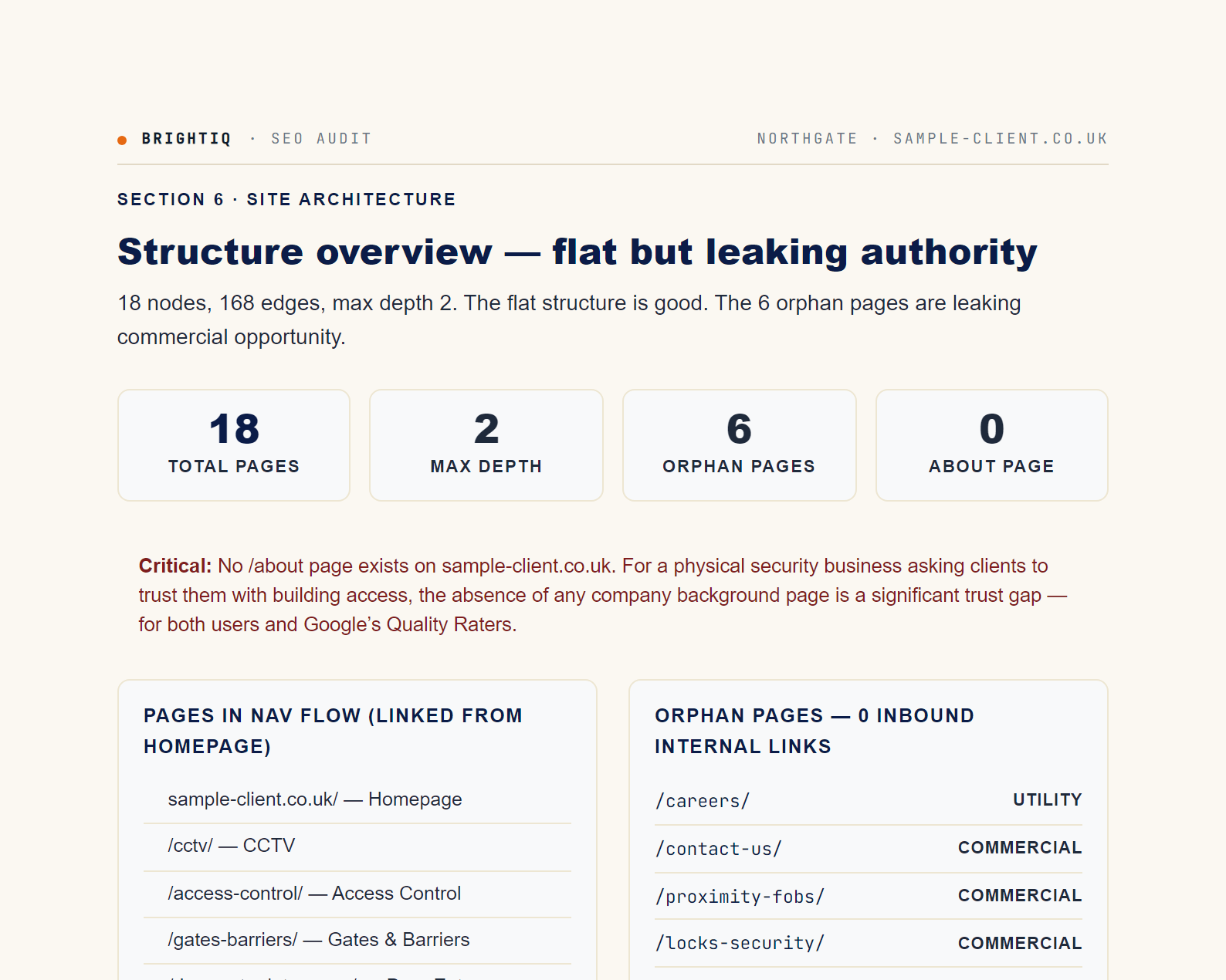
A BrightIQ Technical SEO Audit is a diagnostic review of your website's technical health, covering crawlability, indexation, orphan pages, index bloat, Core Web Vitals on your key pages, security headers, redirect chains and redirect loops. Each finding is delivered as a fix you can action directly.
How a BrightIQ technical SEO audit works, on one real job
One real technical audit of a UK property-services organisation, anonymised: every page read in a real browser, the findings challenged and re-measured by Nora, and what was really wrong.
Is your technical audit a list nobody acts on?
You have probably had the export. A spreadsheet arrives with a long list of flagged issues, none ranked, none explained. Your developers read it, agree it looks bad, and quietly get on with the sprint instead.
Most audits weight every finding equally, yet most of what gets flagged will never move your traffic. Time spent on those is time taken from the fixes that would. Fixed-path audits also leave gaps, skipping how well your pages are written, whether content meets E-E-A-T, and how internal linking is structured.
As things stand, your team spends effort on low-impact fixes while the problems holding your rankings back stay put. The audit I built ranks every finding by its effect on traffic and explains each fix in terms you understand.
Five steps from data to signed-off fixes
The audit runs in five steps, each feeding the next. You supply the context, the system does the heavy checking, and I verify the findings before anything reaches you.
What does your existing data already show?
Your Search Console access, existing docs and business context come in first. I compile them into a brief, the starting point for everything after.
What is on the site, page by page?
It uses a real browser, so JavaScript-rendered pages are seen the way Google sees them. It uses a real browser, so JavaScript-rendered pages are seen the way the crawler sees them.
How serious is each finding?
The rules engine runs first, then the judgement checks, with a validator between them. Every finding gets a score and a grade.
Are the findings right?
I run two QA passes. The technical pass checks data quality, including pages, scores, orphans and false positives. The SEO pass checks each finding is correct and fits your industry.
What do you take away?
The system builds the report, the issues spreadsheet mapped URL by URL, the action tracker and deployable schema files. I sign off on the full set.
One signed-off set of fixes
The five steps combine into a verified report, a URL-by-URL issues list and an action tracker you can work from.

What you get
You get a list of what is broken on your site, written so your developer can act on it straight away.
Crawlability
You see which pages search engines can and cannot reach, so you stop guessing why new content is not appearing.
Indexation
You learn which of your pages search engines have stored and which they have dropped, so you can fix the ones that should be showing in results.
Orphan pages
You find pages with no internal links pointing to them, so you can link them in rather than maintaining content nobody can reach.
Index bloat
You find low-value pages cluttering search results, so you can remove or consolidate them and let your strongest pages carry the weight.
Core Web Vitals on your key pages
You see which key pages fail Core Web Vitals and on which measure, so your developer knows where to start.
Redirect chains
You see every redirect that sends a visitor through two or more hops, so you can point each link straight at its final destination.
Findings ranked by what moves your traffic
Each finding is written for the site in front of you, in plain language your developer can act on directly.
Ranking what to fix first is my job, not the tool's. Some flagged issues won't move your traffic, while a few small ones together can do real damage, so I decide the order for your site.
A clear fix list, Core Web Vitals failures traced to the element, a list of orphan pages and a map of redirect chains, back in 48 to 72 hours.
What changes after the audit?
Within 48 to 72 hours of go-ahead, you have a full technical picture of your site: what's blocking indexation, what's slowing pages, and what to fix first.
The crawl starts across your site, covering crawlability, indexation, orphan pages, redirect chains and security headers.
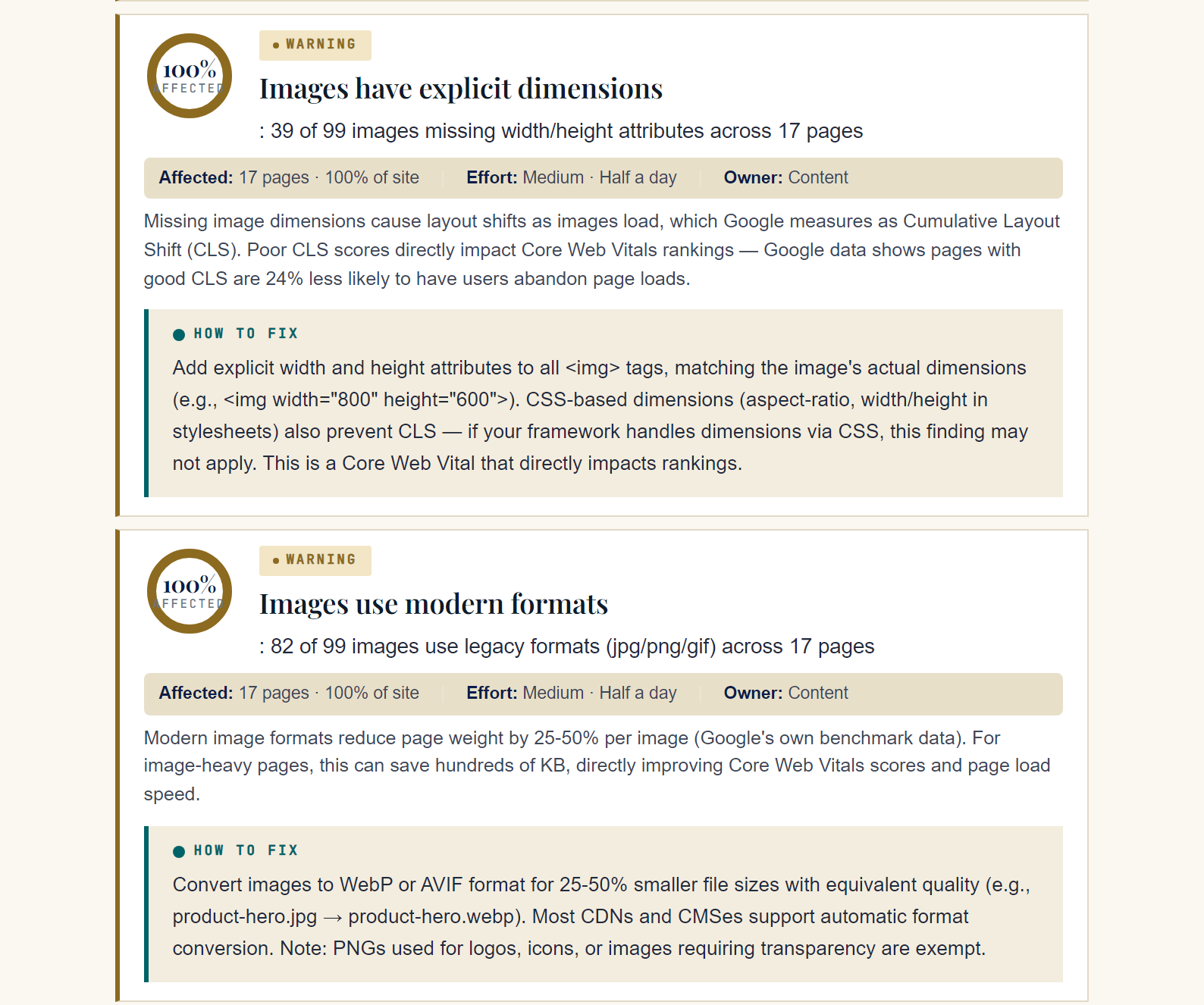
I check Core Web Vitals on your key pages, validate canonicals, robots.txt, sitemaps and hreflang, and compare JavaScript-rendered output against the HTML.
You receive the report, with the site architecture graph, the causes behind each issue, and a prioritised fix list.
Every issue is on the spreadsheet. If your developer works with AI, they can hand it the spreadsheet and it breaks the fixes into tasks. That's the point of the audit: a structured way to fix things, not just a list.
How is this different from Screaming Frog / SEMrush?
| Screaming Frog / SEMrush | The BrightIQ Technical SEO Audit | |
|---|---|---|
| The output | An undifferentiated export | A diagnosis, each finding building on the last |
| Order | No order, no reasoning | Ranked by what will move traffic, with the reason |
| Core Web Vitals | A score | The element causing each failure |
| False positives | Left in the list | Removed in a human check, with a dated ledger |
| Written for | Whoever can read the export | Your developer, technical or plain English |
The audit has to read as a diagnosis, where each finding builds on the last, or it does not get actioned.
Three ways to work together
One-off audit
A single technical audit with the prioritised fix list, back in 48 to 72 hours.
The Agency Plug-in
The audit under your agency's brand, written to the depth your client expects.
The BrightIQ Engine
A monthly re-crawl that catches new technical issues and checks every fix on the live site.
Why trust me with this?
I'm Sebastian Beaton, and I've spent 17 years in SEO, so I built and run this audit myself. Most audits return identical output and leave the fixing to you. Mine gives a diagnosis, each finding building on the last and ranked by traffic impact. In one 1,040-page crawl, 98% of discovered pages, it produced 29 prioritised development actions. A human check removes false positives, and a dated ledger records each rule I've downgraded. I don't take on web design and development, paid ads, social media or team replacement.
Who built this
Every system, every pipeline, every deliverable, built and maintained by one person.

Credentials
Experience
I built the audit system to run this way because almost every other audit I have ever had runs in one specific way, so you get the same output structure for every website you put in. They also generally never answer how to fix it. That is left up to whoever is doing the audit. This system lets me create a bespoke audit that fits your requirements and is written in a way you understand. That is the whole point of it. It gives you the opportunity to see what is wrong and to fix what is wrong, in a way you understand.
Why this matters
- ✓ Modular, not fixed-path. You choose what it looks at, so what comes back is bespoke to your site and written in a way you can actually understand.
- ✓ One document, every reader. A developer works from the spreadsheets and fixes the problems; a marketer uses the report to explain the issues. Nobody needs it translated first.
- ✓ Findings are ranked, not listed. Most issues an audit flags will not move traffic, and this separates the ones that will.
Frequently asked questions
Is this audit right for my website if my developers will action the fixes?
Yes, if your developer or technical lead will action the fixes directly. The audit gives you the infrastructure findings in one place: crawlability, indexation, orphan pages, redirect chains, and Core Web Vitals on your key pages. If you want the list and will act on it yourself, it fits well.
How do you make sure I only fix what matters?
I rank every finding by its likely effect on traffic, not by how many errors a tool counts. Most flagged issues won't shift your visits, so I separate those from the problems that do. The same issue can hurt one site and do nothing on another, so that context sets the order.
What makes your audit different from a standard technical audit?
Standard audits run one fixed path and give every site the same output, with no guidance on fixing it. I build each audit around your site. You choose the crawl tiers and report tiers independently, so the scope matches your needs and the write-up reads the way you do.
Does the audit cover content and internal linking, or only technical issues?
It covers both. Free audits often miss how well your pages are written, whether content meets E-E-A-T, and how internal linking is structured. My audit is built to cover those gaps alongside the infrastructure checks, so the findings show the whole picture rather than just the crawl errors.
Can my developers work through the findings on their own?
Yes. Findings arrive as a diagnosis, where each one builds on the last, so the order and reasoning are clear. Reports are written technical or non-technical, so your developers get the detail and your stakeholders get the summary. Each item is set out so a developer can action it directly.
Has an audit like this led to real work being done?
The audit is built for it. Every issue is on the spreadsheet with its URL, so your developer can turn it into tasks straight away. That's the purpose: a structured way to actually fix things, not just a list of errors to look at.
Related services
Know exactly where you stand
When you book, I'll tell you what the audit checks on your site and what comes back, so you know it's the right one before you order.
- Book a callSend your details and I reply within one working day.
- Scope agreedI confirm what you get and the delivery date before any work starts.
- DeliveredIn 48 to 72 hours, from the day I have access.