For founders and operations leads
AI consultant for small business
The AI Strategy Day
I work as an AI consultant for small businesses, and the AI Strategy Day is where it starts: a half or full day with your team mapping where AI can help, then a roadmap you can act on. AI can fetch the data. The strategy is a human decision.
A half or full day with your team to map where AI pays back first, check feasibility and leave you with an actionable roadmap.
The AI Strategy Day is a half or full day workshop with your decision-makers that maps your AI opportunities, checks their feasibility and produces a ranked opportunity map, implementation roadmap and ROI projections. You bring your processes, data and constraints. I bring the automation and implementation experience.
How the AI Strategy Day works
The steps of the service: a brief before the day, opportunities mapped and feasibility tested live with your team, each one ranked and costed from your own numbers, then a roadmap with owners and a follow-up call where you decide what goes first.
Can you see the AI opportunities but not know which ones will pay back?
A lot of businesses can see AI opportunities. The harder question is which ones will work inside your own processes, with your data and the team you actually have.
Stalled pilots usually have a good idea and a willing team, but nobody ranked the options or checked the data. Most people's mistake is buying a strategy deck. A deck lists possibilities; it does not rank them, cost them or say who can deliver them, so it ends up on a shelf.
Each month of drift costs you budget and the team's patience. The AI Strategy Day gives you a half or full day with your team to rank the opportunities, check feasibility and build a roadmap with return projections from your own numbers.
Four steps from brief to agreed plan
Four steps, each handing you something concrete: you brief me, you and I work through the opportunities together, I write up the plan, then you and I agree what happens next.
What does your business need from the day?
You tell me about your business, processes and goals before the day. It is a short brief.
Which processes are worth automating, and in what order?
Over a half or full day, you and I map opportunities, check feasibility and prioritise live with your team.
What do you do first, and how is it built?
I produce the roadmap and supporting documents after the workshop.
What happens once the roadmap is in your hands?
In a 30-minute call, you and I review the roadmap together and agree the next step.
One prioritised roadmap
The brief, the ranked shortlist and the follow-up call combine into a single plan, ranked by impact, with the next step agreed.

What you get
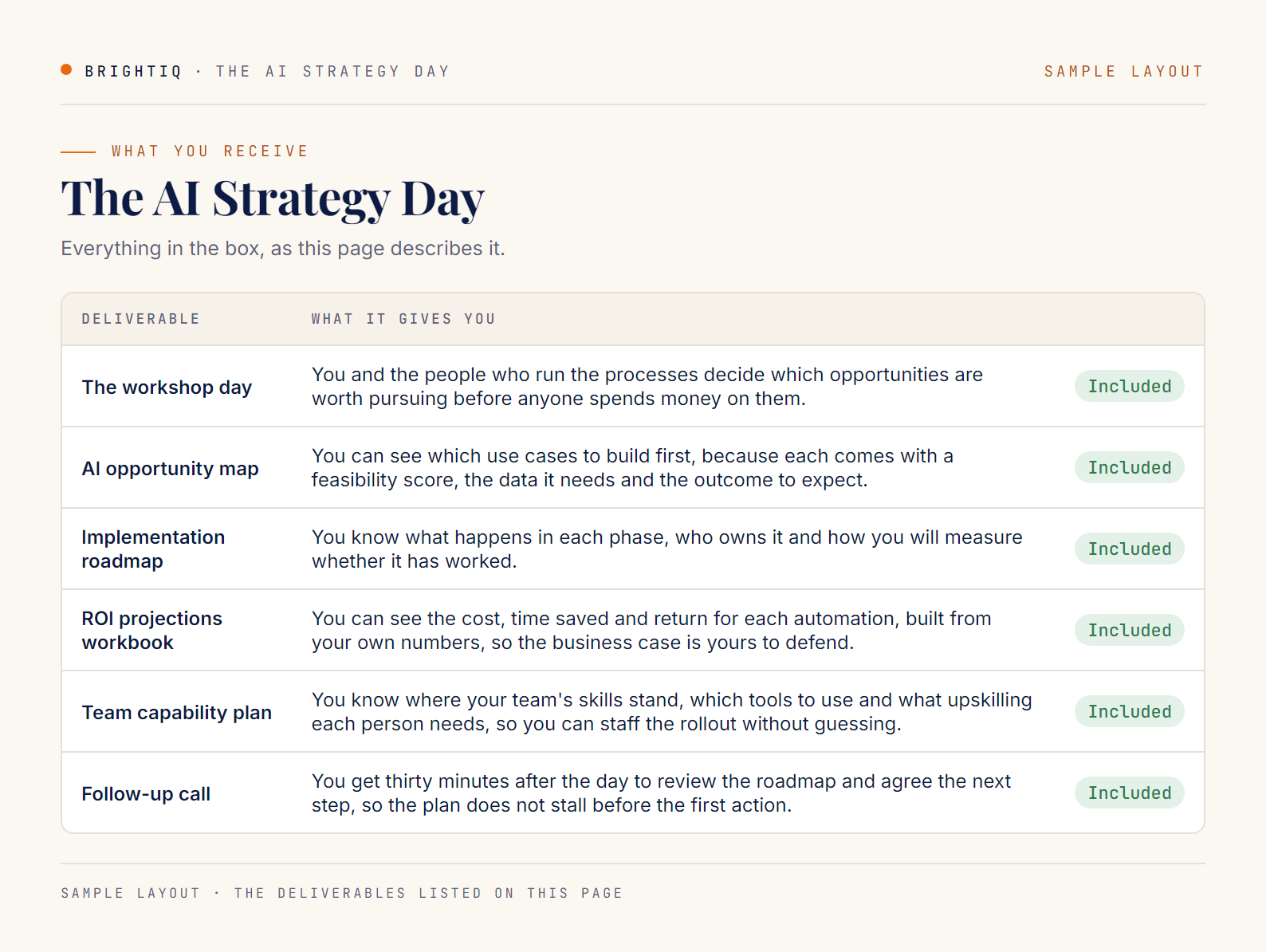
You leave the day with a ranked plan your team can start on, not a deck that sits on a shelf. Six things come out of it.
The workshop day
You and the people who run the processes decide which opportunities are worth pursuing before anyone spends money on them.
AI opportunity map
You can see which use cases to build first, because each comes with a feasibility score, the data it needs and the outcome to expect.
Implementation roadmap
You know what happens in each phase, who owns it and how you will measure whether it has worked.
ROI projections workbook
You can see the cost, time saved and return for each automation, built from your own numbers, so the business case is yours to defend.
Team capability plan
You know where your team's skills stand, which tools to use and what upskilling each person needs, so you can staff the rollout without guessing.
Follow-up call
You get thirty minutes after the day to review the roadmap and agree the next step, so the plan does not stall before the first action.
A plan you act on, not a list to file away
Each phase has a timeline, named owners and a success measure you can check. Open it on Monday and you know what starts first and who starts it.
Which initiative goes first is your call, not mine. I set out the options and the trade-offs; you decide based on what your team can absorb this quarter.
A half or full day mapping your AI opportunities with your team, then a phased roadmap, ROI workbook and team capability plan within 5 working days.
What changes after the workshop?
The workshop ends with a shared view of where AI fits your business, and the written pack follows.
I map your AI opportunities with your team in the session, and you leave with them listed and ranked.
I build the phased roadmap, ROI workbook and team capability plan from what we mapped.
You receive the full pack, ready to act on.
By the end of the fifth working day you hold a plan your team can act on, with the ROI workbook showing which steps pay back first and who owns each one. The priorities come from your own operations, not from a generic AI checklist.
How is this different from a strategy deck?
| A strategy deck | The AI Strategy Day | |
|---|---|---|
| What you leave with | A deck you shelve | A roadmap you can execute |
| Opportunities | Listed | Ranked with feasibility scores and data requirements |
| Your team | Not covered | A capability and upskilling plan |
| After delivery | Handed over and done | A follow-up call to review the roadmap |
You walk out with a plan you can execute, not a deck you will shelve.
Three ways to work together
The Automation Audit
Already know you want to automate? A process-first audit ranks your top five opportunities by return.
The AI Strategy Day
A half or full day with your team, then the roadmap, ROI workbook and capability plan.
The Workflow Build
When the roadmap is agreed, I build the first system and hand it over, or run it for you.
Why trust me with this?
I'm Sebastian Beaton, with automation experience and 17 years in SEO. Strategy decks list AI possibilities without ranking or costing them, so they end up on a shelf. I shape the day around your business so you leave with a roadmap you can execute: ranked opportunities, feasibility scores, returns worked out from your own numbers and a capability plan for your team. You bring your processes, data and constraints. One person builds and runs every system, and a follow-up call reviews the roadmap. I don't do web design, paid ads, social media or team replacement, since.
Who built this
Every system, every pipeline, every deliverable, built and maintained by one person.

Credentials
Experience
The difference between an AI pilot that pays back and one that stalls is strategy. I shape the day so you walk out with a plan you can execute, not a deck you will shelve.
Why this matters
- ✓ You bring your processes, data and constraints; I bring the automation and implementation experience.
- ✓ Opportunities ranked with feasibility scores, data requirements and expected outcomes.
- ✓ Returns worked out from your actual numbers.
Frequently asked questions
Is this right for my business if we're not a tech company?
Yes, if you run a business where processes, data or repetitive work cost you time. The day suits founders or MDs, operations leads and team heads, usually a small group. You do not need to be a tech company. The real question is where AI pays back first in your processes.
How do you make sure the plan gets used rather than shelved?
By making sure every opportunity is ranked, costed and assigned before we finish. A strategy deck lists possibilities but does not rank them, cost them or say who delivers, so it gets shelved. You leave with a phased roadmap and an ROI workbook built from your numbers, which you can act on.
Do I need to know anything about AI before the day?
No. You bring your processes, your data and your constraints, and I bring the automation experience and implementation knowledge. Knowing where time goes in your week matters far more than knowing the tools. You and I build the technical picture together on the day.
Can I trust the return figures before committing budget?
Yes, because the figures come from your own numbers, not an industry average. The ROI workbook shows cost, time saved and return for each automation, so you can see which ones pay back and how quickly. I check the inputs with your team on the day, so the projections are yours to challenge.
Why run it as a workshop with my team instead of a report afterwards?
Because the people who own the processes know where the real constraints are. The day includes live prioritisation with them, so feasibility gets tested in the room rather than guessed from a distance. Two to five people keeps decisions moving quickly.
What happens after the workshop day?
You get a thirty-minute follow-up call to review the roadmap and agree the next step. That call is where we decide which initiative starts first and who owns it. The plan is written down, so the follow-up is about moving it forward, not chasing a report.
Related services
Know exactly where you stand
When you book a call, I'll talk through where your business is now and whether the AI Strategy Day is the right fit. You'll know by the end of it whether the day is worth your time.
- Book a callSend your details and I reply within one working day.
- Scope agreedI confirm what you get and the delivery date before any work starts.
- Built for youThe AI Strategy Day is built for your business, on the date agreed with you.