For businesses ready to automate
An AI automation audit, process first
The Automation Audit
An AI automation audit is a review of how your business works, to find which manual jobs are worth automating first. It is not an audit of an AI system for risk or compliance. I map the process from start to finish before I build anything, then I rank the top five by return.
I assess your operations, map manual workflows and pick the top five automation opportunities by return, with a roadmap you can act on.
The Automation Audit is a structured assessment that maps every manual workflow in your business, scores each one by return and identifies the top five automation opportunities with a concrete implementation roadmap. You receive specific deliverables, not a slide deck of vague recommendations.
How the Automation Audit works
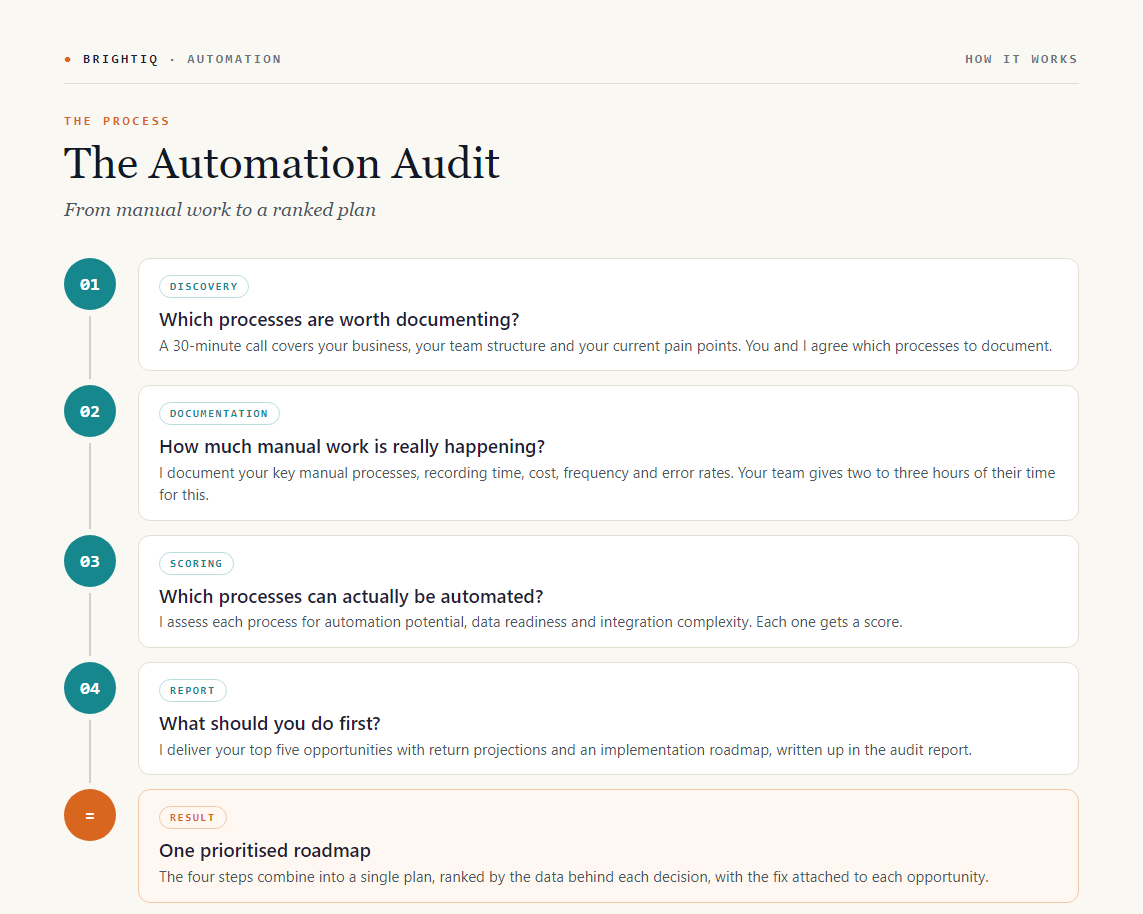
The steps of the service: the processes worth documenting agreed with you, each one measured for time, cost, frequency and error rate, scored for automation potential and data readiness, then the top five ranked by return in a roadmap you can act on.
Do you know which manual process is costing you the most?
Most businesses know they have manual work that should be automated. Someone re-keys figures every week, and new enquiries wait in an inbox until somebody has time.
Knowing automation exists is not the hard part. Knowing which process will pay back is. Start with the wrong one and you can waste months on a project that saves two hours a week. The usual mistake is jumping in before checking data readiness, process complexity and integrations. That's how expensive pilots go nowhere.
Staying put means the same hours keep draining into manual work. The audit maps your workflows and names the top five opportunities by return, with a concrete roadmap. That roadmap is yours to act on, with me, another provider or in-house, no strings attached.
From manual work to a ranked plan
Four steps take your manual work from a call to a ranked, costed plan. I do the analysis. Your team's input is a short call and a few hours of process time.
Which processes are worth documenting?
A 30-minute call covers your business, your team structure and your current pain points. You and I agree which processes to document.
How much manual work is really happening?
I document your key manual processes, recording time, cost, frequency and error rates. Your team gives a few hours of their time for this.
Which processes can actually be automated?
I assess each process for automation potential, data readiness and integration complexity. Each one gets a score.
What should you do first?
I deliver your top five opportunities with return projections and an implementation roadmap, written up in the audit report.
One prioritised roadmap
The four steps combine into a single plan, ranked by the data behind each decision, with the fix attached to each opportunity.
What you get
You get six deliverables that tell you which manual work to automate first, what it takes to build it, and what could stop it.
Process map
You can see every manual workflow with its time, cost and frequency, so you know where your hours actually go.
Priority matrix
Your top five opportunities are scored and ranked with the data behind each one, so you know which to automate first.
Implementation plan
Each opportunity comes with its tools, timeline, cost estimate and expected outcome, so you can approve or reject it on the numbers.
Fast-start list
You get automations you can switch on early, with instructions, so you see a return before the larger project begins.
Data readiness review
Data quality, access and integration points are checked before any build, so you don't pay for a pilot that stalls on bad data.
Blocker map
Dependencies and blockers are identified at the start, so the build doesn't stop halfway through.
A roadmap you can act on straight away
Start with the priority matrix: the top five opportunities, ranked, each with its numbers. Every one ends in a clear next step your team can act on.
I start from the process, not the tool. Whether you build it with me, another provider or in-house is your call, with no strings attached.
Your manual processes mapped, the top five automation opportunities ranked by return, an implementation plan and a fast-start list, timed and agreed before I start.
What changes after the audit?
Before work starts, you and I agree a delivery date in writing. At handover you hold a mapped process list, a ranked top five and a fast-start plan.
I map your manual processes with you and agree the delivery date in writing.
I review each process for automation potential and rank the top five opportunities by likely return.
You receive the implementation plan and fast-start list, ready to act on straight away.
You stop guessing where automation pays. You know which processes to automate first, what each one is likely to return, and what to do next. Whether you build it yourself or bring in help, the decisions are already made.
How is this different from jumping straight to a build?
| Jumping straight to a build | The Automation Audit | |
|---|---|---|
| Where it starts | The technology | The process |
| What is measured first | Nothing: the build starts | Time, cost, frequency and error rate per process |
| Data readiness | Found out mid-project | Checked before you build |
| Which process first | A guess | Ranked by return, feasibility and complexity |
| The result | Often an expensive pilot that goes nowhere | A roadmap with a fast-start list |
My audit starts with the process, not the technology.
Three ways to work together
The Automation Audit
The audit and roadmap on their own, yours to implement with anyone.
The Workflow Build
I build the top-ranked automation from your roadmap and hand it over for your team to run.
Build and run
I build it and run it for you each month, with changes handled as your process evolves.
Why trust me with this?
I'm Sebastian Beaton. I've spent 17 years in SEO, and I build and run my own automation systems, from my audit engine to my outreach system. Knowing automation exists is not the hard part; finding the process that pays back is. Before recommending anything, I measure time, cost and error rate per process, check data readiness, then rank by return. Jumping straight to a build is how you end up with an expensive pilot that goes nowhere. I don't do web design, paid ads, social media or team replacement. The roadmap is yours, with me or without.
Who built this
Every system, every pipeline, every deliverable, built and maintained by one person.

Credentials
Experience
The challenge is not knowing automation exists. It is identifying which specific process will deliver the highest return. Start with the wrong one and you waste months on a project that saves two hours a week. So my audit starts with the process, not the technology.
Why this matters
- ✓ Process first, not technology first.
- ✓ Every process measured for time, cost, frequency and error rate before anything is recommended.
- ✓ Data readiness and integration blockers found before you start building.
Frequently asked questions
Is this right for my business?
Yes, if you know manual work is eating your time but you don't yet know where to start. It suits businesses across operations, sales, marketing, finance and HR. Even if you already have a project in mind, the audit will show whether it's the right one to start with.
How do you make sure I start with the process that pays back?
I start with the process, not the technology. Every manual workflow gets documented with its time, cost and frequency, then the top five opportunities are scored and ranked by return, with the data behind each decision. Picking the wrong process is how months get lost on a project that saves two hours a week.
How do you make sure the build doesn't stall halfway through?
Before anything gets built, I check data quality, accessibility and integration points, then map every dependency and blocker. That way the problems surface during the audit, not in the middle of a build. You get the full picture first, so the implementation plan you act on is one that can actually finish.
Can I act on the roadmap without hiring you?
Yes. The report belongs to you, so you can implement it with me, with another provider or in-house. There are no strings attached. I'd rather you have a roadmap you can use than one that keeps you dependent on me, and that's why I write it to be actioned by whoever picks it up.
Will I see a quick win before the full build starts?
Yes. The audit includes a fast-start list of automations you can put in place early, with instructions to begin. You don't have to wait for the full roadmap to see something working. The quick wins build confidence and give you a real result to judge the larger projects against.
Can the report be understood by people who aren't technical?
Yes. Reports are written in technical or non-technical language, so the people who approve budgets can read the same report as the people who build the automations. Every opportunity comes with its tools, timeline, cost estimate and expected outcome, which makes the decision easy to explain internally.
Related services
Find out which processes to automate first
When you book a call, I'll look at how your work actually runs before anything else, so you leave knowing which steps are worth automating and which aren't.
- Book a callSend your details and I reply within one working day.
- Scope agreedI confirm what you get and the delivery date before any work starts.
- Built for youThe Automation Audit is built for your business, on the date agreed with you.