For agencies writing service pages
A service page writer for UK businesses
The Service Page Pack
A service page writer for UK businesses. I turn one core service into a focused page for each industry or area you want to win, written in the first person with your proof. I see businesses lean on blog posts and neglect their business pages. First batch back in 48 hours.
I turn one core service into a focused page for each industry or area you want to win, in your voice.
The Service Page Pack is a done-for-you service that turns one core service into a first-person page for each industry or area you want to win, delivered with its title tag, meta description, JSON-LD service schema and planned internal links.
How the Service Page Writer works: one real job
Follow one real job for a home renovation firm, anonymised: the client answers a question sheet first, every line of the brief points to an answer, and each page is checked so nothing the firm never promised reaches the page.
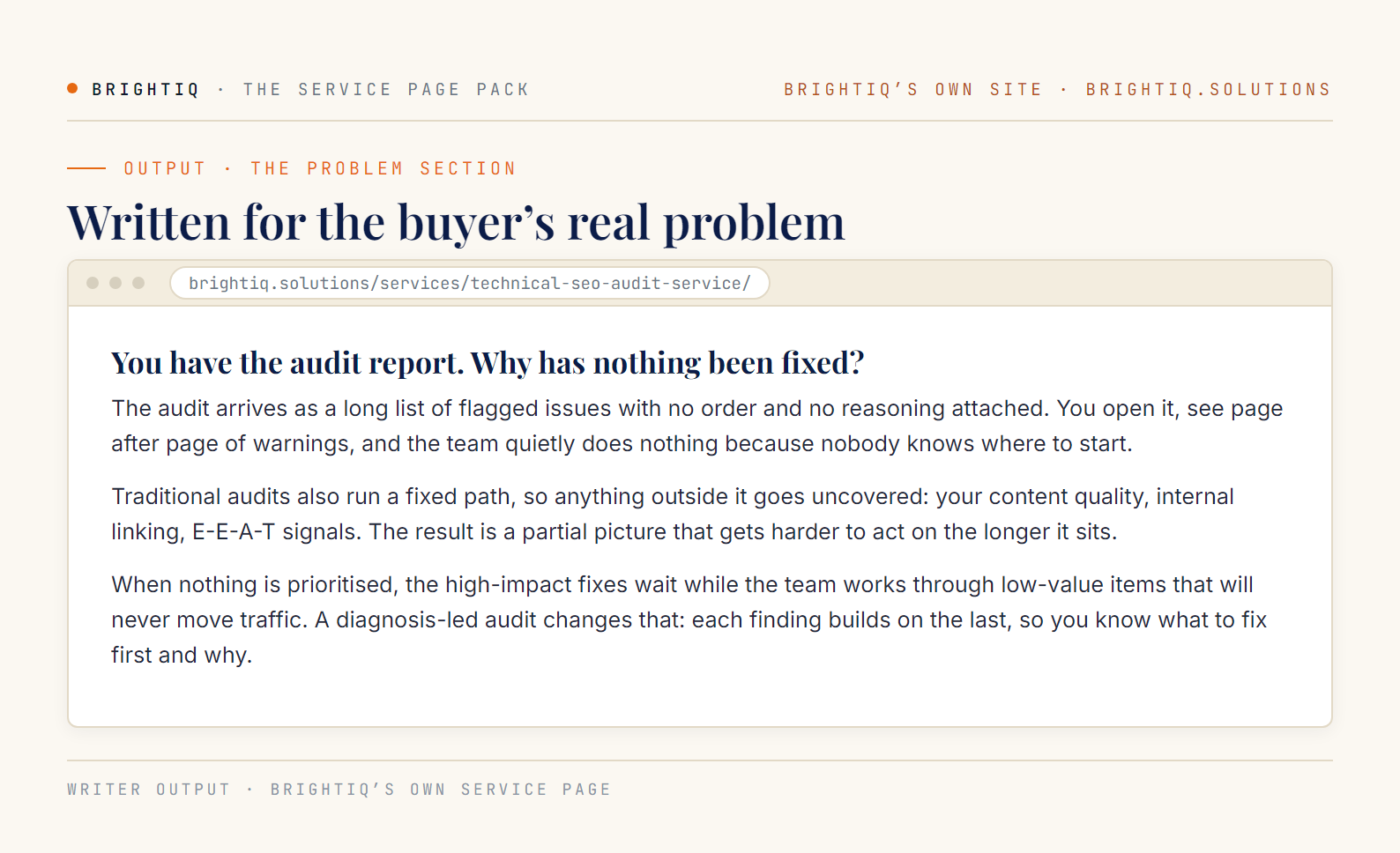
Is your one service page trying to speak to everyone?
Most service pages are written once and asked to do everything. One page tries to rank for every industry and every area, so it connects with no one. Visitors can tell it was not written for them.
Searchers are specific. They want a service for their industry, in their area, and a generic page does not match that search. Stretching one page across every audience is the usual mistake.
One page cannot answer all of them. Writing a focused page for every segment by hand is the job that never gets done. The Service Page Pack writes each one for you, in your voice and with your proof, so no segment goes without.
Send the brief, then review the finished set
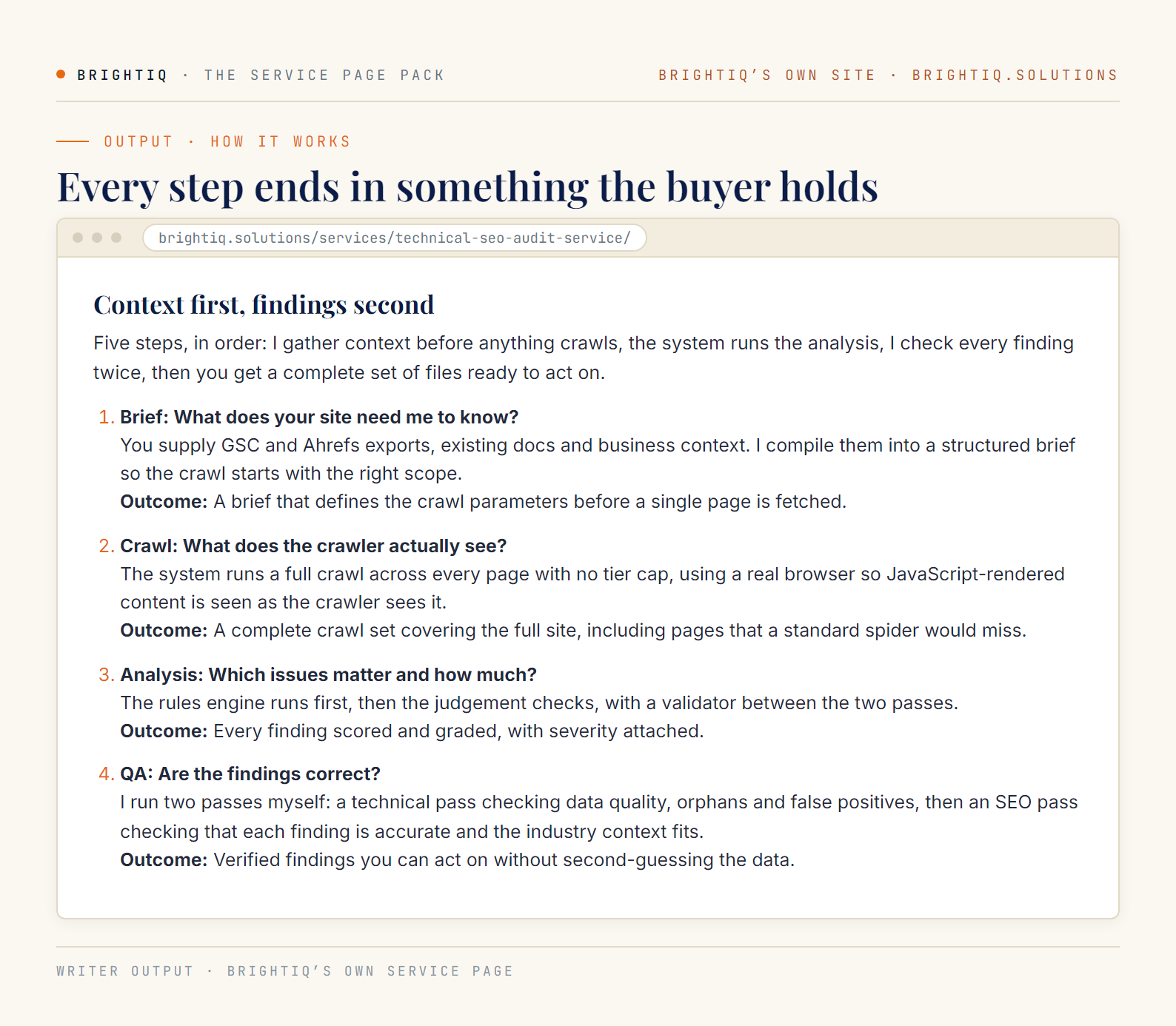
Four steps take you from a brief to a finished set. You supply the knowledge, the system plans and writes, and you finish the last details before going live.
Which service should I write about?
You send the core service, what it covers, the segments you want and the proof you want to lead with.
Which segments earn their own page?
The system checks the search intent and the pages already ranking for each keyword. Each segment worth a page gets its own target keyword.
Does each page sound like you?
The system writes each segment's page in your voice, with metadata, schema and planned links. Any page that breaks a rule is held for my review.
What is left to fill in?
You receive the set, the link plan and any details still marked for you. Fill those in, then publish.
One finished set, built from your brief
The brief, plan and checked pages combine into a complete set that you finish and publish.

What you get
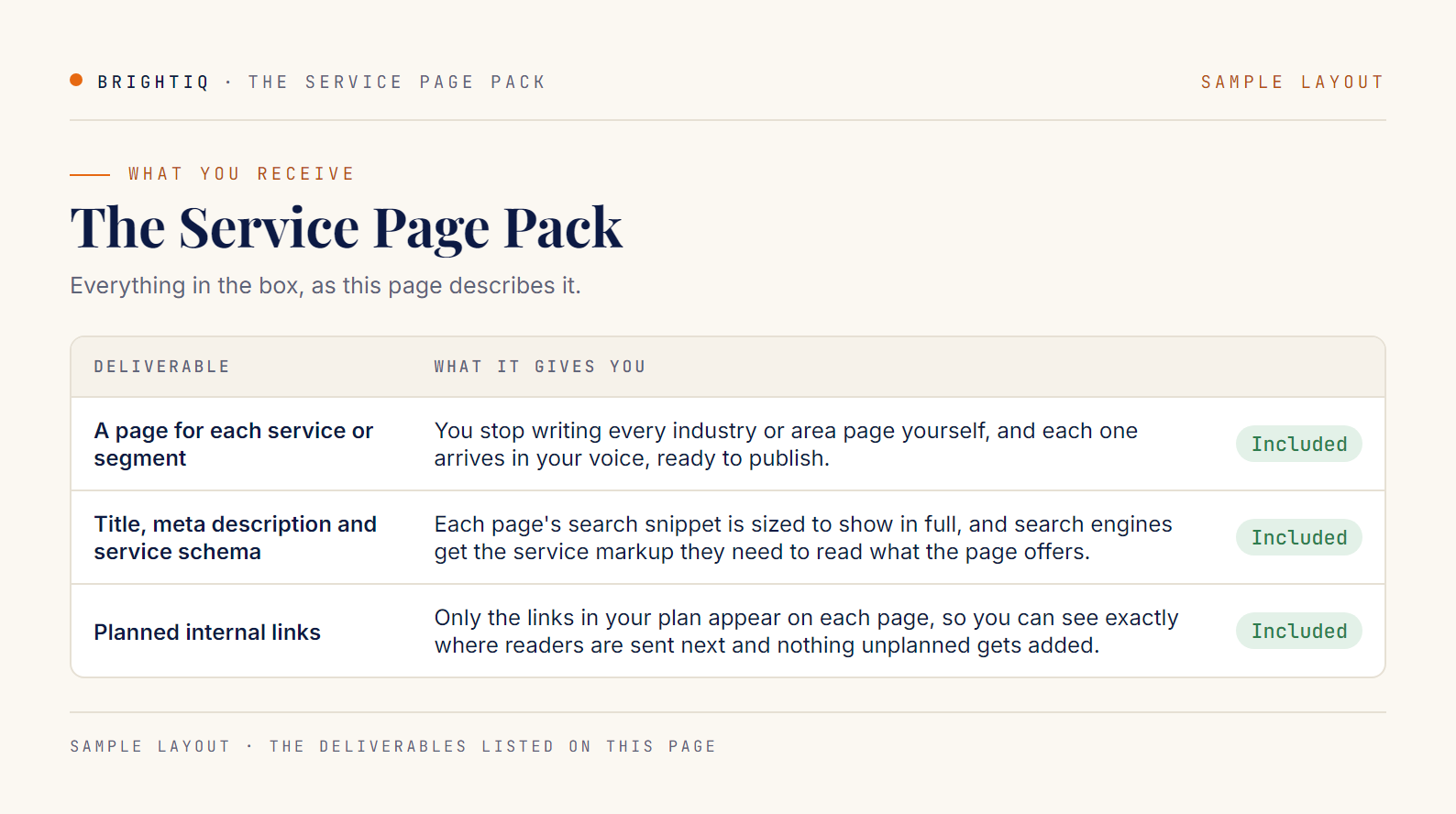
Every Service Page Pack gives you three things, each one matched to a job you would otherwise do by hand.
A page for each service or segment
You stop writing every industry or area page yourself, and each one arrives in your voice, ready to publish.
Title, meta description and service schema
Each page's search snippet is sized to show in full, and search engines get the service markup they need to read what the page offers.
Planned internal links
Only the links in your plan appear on each page, so you can see exactly where readers are sent next and nothing unplanned gets added.
A page you can publish, not a draft to rebuild
Each page reads as one piece in the first person, with your proof in place of general claims. Read it as a customer would, then fill the marked gaps.
I choose the segments and structure, but you decide which accreditations and guarantees stand on the page, because only you can back them.
A ready-to-paste page for each segment, with its title, meta description, service schema and internal link plan, first batch back in 48 hours.
What changes after the pack?
Within 48 hours of your brief, you have the first batch: a ready-to-paste page for each segment, with its search snippet and planned links already in place.
Your brief is in and the page plan is set, with one target keyword for each segment worth a page.
The first batch lands, and every page is checked against the rules before it reaches you.
You fill any gaps I have marked, then publish the set.
Every segment you want to win ends up with a page written for the search it answers, in your voice.
How is this different from one generic service page?
| One generic service page | The Service Page Pack | |
|---|---|---|
| Who it speaks to | Everyone, so no one specifically | One industry or area per page |
| Search intent | One page stretched across every search | Each page written around its segment's search |
| Internal links | Nothing to connect | Only the links you plan, across the set |
| Schema | One block for every segment | Service schema per page |
One generic page tries to rank for everything and speaks specifically to no one.
Three ways to work together
Pages from your brief
A page for each service or segment you brief me on, with the first batch back in 48 hours.
White-label for agencies
Service pages for your clients, delivered under your agency's brand.
Alongside an audit
Your existing service pages rewritten as part of putting an audit's fixes in place.
Why trust me with this?
I'm Sebastian Beaton, and I build the system behind these pages, with 17 years in SEO behind every plan. Most service pages try to rank for everything, and that is the mistake this pack avoids. Each segment gets its own page, written around the search it answers, and only the internal links in your plan appear. One person builds and runs every system, so nothing is handed to a junior. I don't do web design, PPC, social media or team replacement.
Who built this
Every system, every pipeline, every deliverable, built and maintained by one person.

Credentials
Experience
I built it because a single generic service page tries to rank for everything and connects with no one. People search for a service for their industry, in their area. A focused page per segment answers that search, without you writing each page by hand.
Why this matters
- ✓ One focused page per segment: the service by industry and, where it helps, by location.
- ✓ Written in the first person, in your voice, with your proof.
- ✓ Only your claims: no accreditations, guarantees or capabilities you did not supply, and any gap left marked for you, never guessed.
Frequently asked questions
Is this right for my website?
Yes, if you sell one core service into several industries or areas and your current page is trying to cover them all. Tell me the service and the segments you want to win, and I'll tell you straight whether a focused page for each one is the right move.
How is this different from a page per town?
A page per town splits your work by place. This pack splits the service by industry and by what the searcher wants, and adds location only where it helps that search. Each segment gets its own page, and the town is layered in where people actually search by it.
Does this work when my service depends on location as well as industry?
Yes. Where a search depends on place, I combine the service, the industry and the location into one target, so each page answers one specific search. Where place does not change what the searcher wants, I leave the location out. That keeps every page tied to its search.
How do you make sure a page never claims something I cannot back up?
Every accreditation, guarantee and capability on the page comes from the details you give me, and I add nothing beyond them. If a point needs a fact I don't have, I won't invent one. You decide which claims stand, because you are the one who has to back them up in person.
What results back up this approach?
Rather than quote a figure from another project, I'll stick to the principle. A page written tightly around one search tends to rank better than a page written for everything. That is the logic behind every segment page this pack produces.
Why not add a section for each industry to my existing page?
One page has one title, one meta description and one search it is trying to answer, so a section for each industry still dilutes the match. A separate page gives each segment its own target search and its own snippet. Sections help readers once they arrive; separate pages are what bring them in.
Related services
Know which segments deserve a page
When you book, I talk through your service and the segments you want to win, and you leave knowing which pages are worth writing first and what the set will cover.
- Book a callSend your details and I reply within one working day.
- Scope agreedI confirm what you get and the delivery date before any work starts.
- DeliveredFirst batch back in 48 hours, from the day I have access.