For online stores
AI automation for e-commerce
Product pages written at scale
AI automation for ecommerce, as I run it, is a bulk content service: unique titles, descriptions and copy for every page in your catalogue, as an import-ready CSV, first batch back in 48 hours. I like doing the product rewrites. That's the fun part for me. Every page is analysed on its own.
I build automations that write unique metadata and product copy for stores whose catalogues are too big to write by hand.
A Clever Automations is a bulk content service that writes unique, keyword-targeted metadata, product copy and category content for every page in an online store's catalogue, using automatic analysis of each page rather than templates. It delivers the finished work ready to import.
How BrightIQ works for online shops
The steps of the service: the catalogue mapped, each page briefed against its existing copy, competitors and search intent, written and checked, then delivered as an import-ready file, with three ways to start.
Can your product pages still be told apart from one another?
Writing unique, optimised descriptions for a full catalogue by hand is not possible, so most stores fall back on templated copy. Every product ends up sounding the same, whatever it actually is.
Products become hard to tell apart, category pages stay thin, and the store is hard to find for the searches buyers actually make. A thin category page gives search very little reason to rank it, and a shopper who cannot tell products apart moves on.
Left as they are, those pages keep falling behind competitors who have taken the time to describe their ranges properly. I build the work to check each page against its existing copy, competitor pages and search intent first, then deliver it ready to import.
Three steps from catalogue to finished copy
Each step feeds the next: the catalogue map comes first, then a brief for every page, then copy written from those briefs for your review.
How is my catalogue structured?
I connect to your platform and map your products, categories and how they relate to each other.
What does each page need?
For each page I read the existing copy, how competitor pages describe it, and the search intent behind it.
What do you get back?
I write the titles, descriptions and copy, then deliver them as an import-ready CSV, with the first batch back within 48 hours. You review before anything is imported.
One brief-led pass
Mapping, briefing and writing run in order, so every page reaches you with its own reasoning and copy ready to import.

What you get
Three pieces of work, each written for a specific page rather than filled from a template.
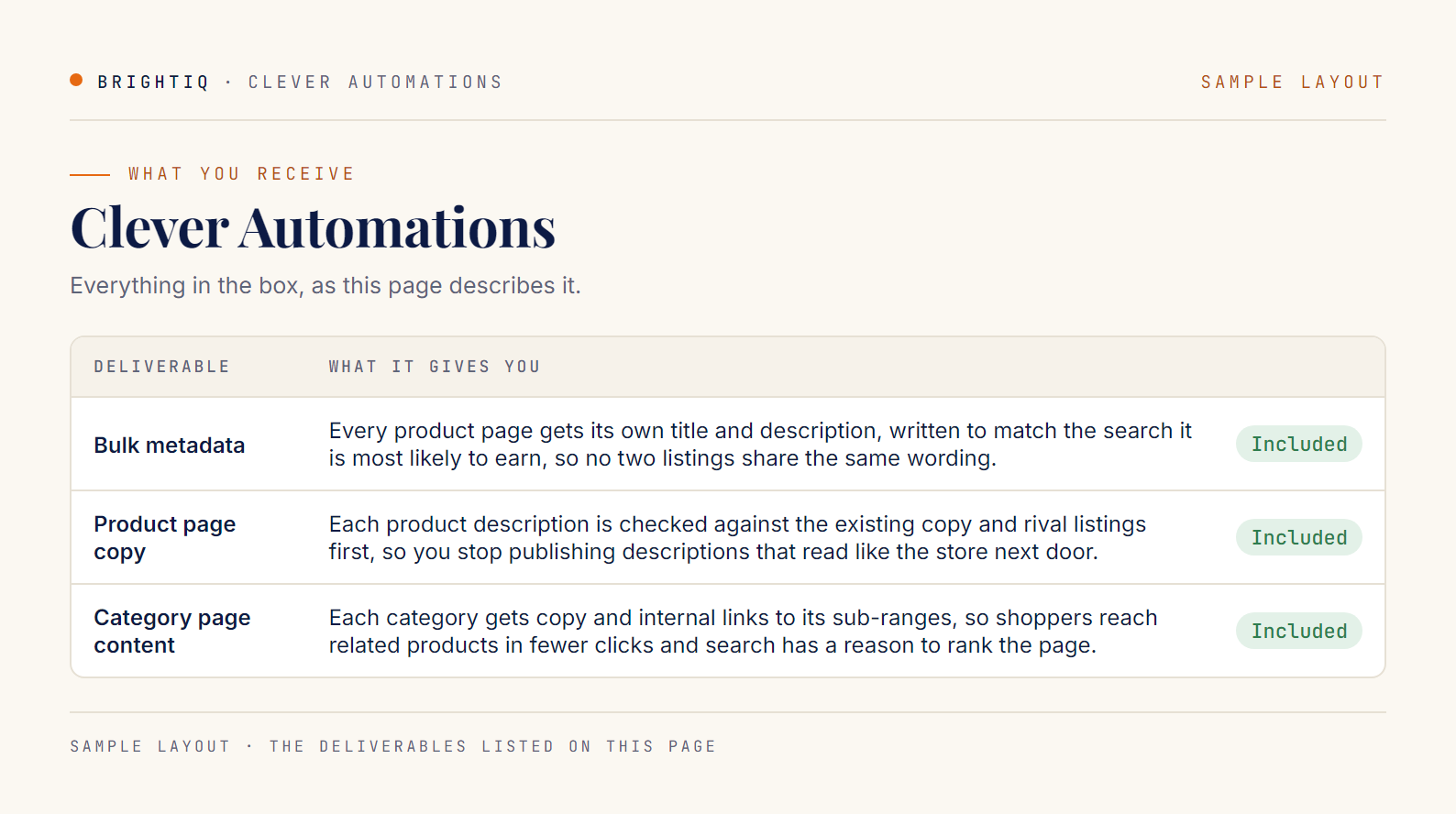
Bulk metadata
Every product page gets its own title and description, written to match the search it is most likely to earn, so no two listings share the same wording.
Product page copy
Each product description is checked against the existing copy and rival listings first, so you stop publishing descriptions that read like the store next door.
Category page content
Each category gets copy and internal links to its sub-ranges, so shoppers reach related products in fewer clicks and search has a reason to rank the page.
Copy you can review and import in one pass
The main file is one spreadsheet, one row per product page, with the title, description and copy for each.
I decide what each page should say from its brief. You decide what stays, since you know the range better than any brief does.
Unique titles, descriptions and product copy across your catalogue, checked against search intent and delivered as an import-ready CSV, with the first batch back in 48 hours.
What changes after Clever Automations?
Within 48 hours of connecting to your store, you hold your first finished pages, ready for your sign-off.
Access to your store is set up, and I start with the pages whose current copy is weakest.
Briefs for the first set of pages are complete, and the writing for them is underway.
The first batch of finished titles, descriptions and category text reaches you.
What you keep is a catalogue where each page says what it actually is, plus a clear view of which pages to fix first.
How is this different from templated product copy?
| Templated product copy | Clever Automations | |
|---|---|---|
| Each page | The same pattern with the name swapped | Its own analysis |
| Search intent | Not checked | Checked before writing |
| Competitor pages | Not considered | Reviewed for every page |
| Niche wording | Generic | Written to your niche's wording rules |
Product discovery and SEO at scale: every product page analysed on its own, not filled from a template.
Three ways to work together
The Metadata Overhaul
A unique title and description for every product page in an import-ready CSV, first batch back in 48 hours.
The Product Page Pack
Unique, brand-matched copy for every SKU, ready to import, first batch back in 48 hours.
The Category Builder
Unique copy for every category and subcategory, with internal links, first batch back in 48 hours.
Why trust me with this?
I'm Sebastian Beaton, and I have 17 years in SEO behind every page I write. Every product gets its own review before any copy is written, so no listing comes from a template. One person builds and runs every system, which means I write each page myself. I don't do web design, paid ads, social media or team replacement.
Who built this
Every system, every pipeline, every deliverable, built and maintained by one person.

Credentials
Experience
Writing unique, optimised descriptions for a full catalogue by hand simply is not possible. So I built the work to run per page: check the existing description, the competitor pages and the search intent, then write.
Why this matters
- ✓ Per-page analysis, not templates.
- ✓ Competitor pages and search intent checked before anything is written.
- ✓ Delivered as an import-ready CSV for Shopify, WooCommerce or any platform.
Frequently asked questions
Is this worth it if my catalogue is only a few hundred products?
Yes, if your range is too big to write by hand. The value grows with the catalogue, so a small store may do better writing its own descriptions. Once a range runs to hundreds of pages, that is where the work matters most.
How do you make sure I only fix what matters?
Before any copy is written, I look at which pages already get search attention and which are being ignored. Effort goes first to pages where a better description can change the result, not to every page equally. That keeps the work focused on the listings that earn the most from it.
What results have rewritten pages actually produced?
Results depend on the store and its starting point, so I'd rather not quote a number that does not apply to yours. On a call, we can look at your own pages and set out what a rewrite should change first.
Will the finished copy work on my platform?
Yes. The finished copy arrives as an import-ready CSV that works on Shopify, WooCommerce or any other platform. The format stays the same whichever one you run, and you can open the file in any spreadsheet before uploading it.
Why not use a template and tweak it myself?
A template gives every product the same skeleton, so the wording stays generic and misses what each shopper is searching for. Editing it later rarely fixes that, because the problem is the approach. Each page needs its own description, checked against what it already says and what competitors publish.
How does this sit alongside the SEO agency I already use?
It sits alongside them rather than replacing them. They keep the strategy, and I handle the execution at catalogue scale, writing the copy for pages that would take too long to do by hand. That split keeps your agency focused on decisions and the catalogue moving.
Related services
Know exactly what your catalogue needs
Book a call and I'll look at a sample of your pages with you, so you leave knowing which ones to fix first and what the first batch would say.
- Book a callSend your details and I reply within one working day.
- Scope agreedI confirm what you get and the delivery date before any work starts.
- DeliveredIn 48 hours, from the day I have access.