For stores with complex catalogues
An AI shopping assistant for ecommerce
The Shop Assistant
An AI shopping assistant for your online store, trained on your catalogue and buying guides, with live stock and pricing, so it recommends the right product. AI makes things up when it's missing information. When I see that, I find the hole in the data and plug it. Scoped before I start.
I build an assistant for your store that knows your catalogue, technical documentation and buying guides, with live stock and pricing.
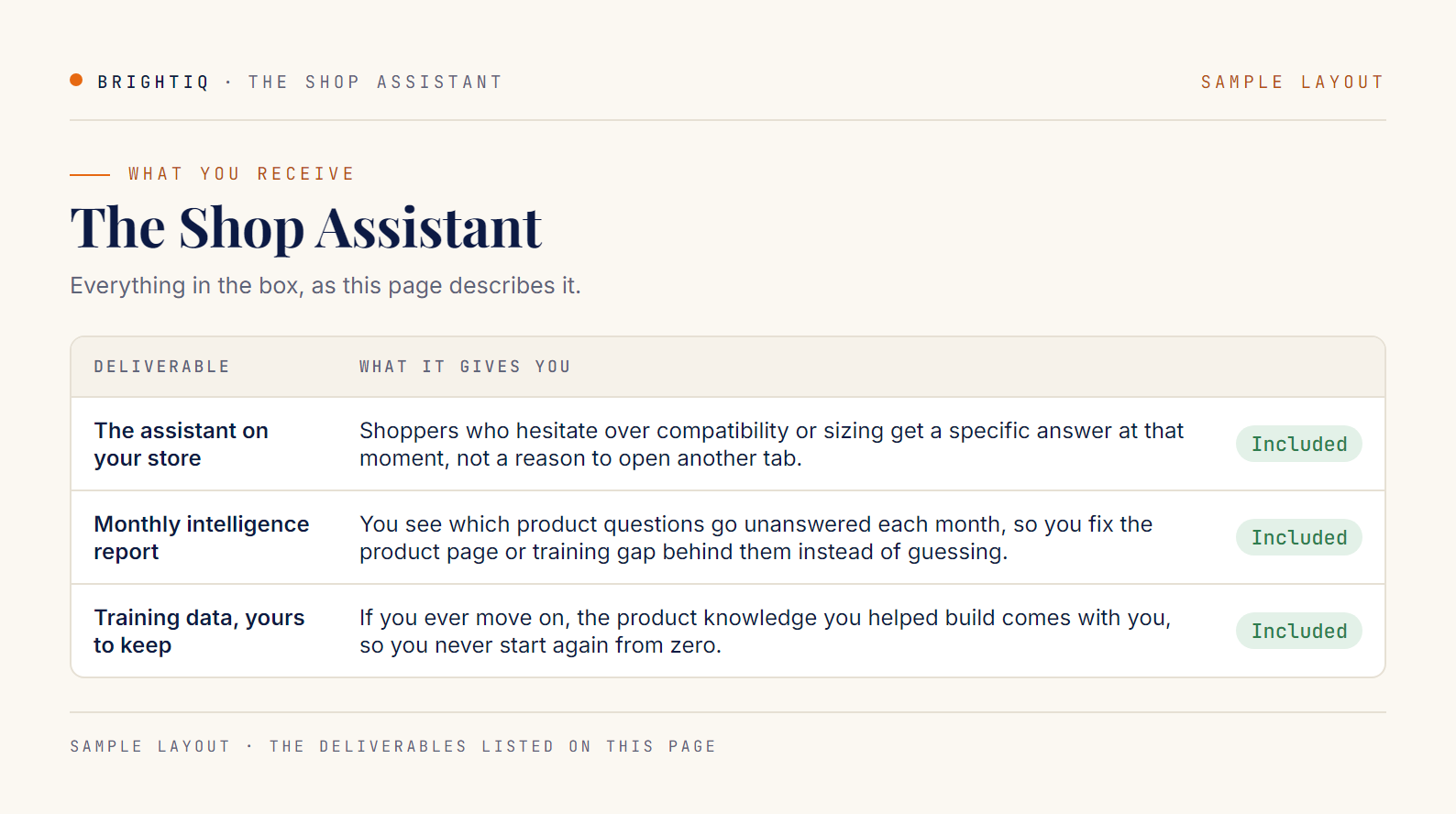
The Shop Assistant is a conversational product advisor for an online store, built from the store's own product data, that answers shoppers' questions and points each one to the item that fits their need. Clients receive the assistant, a monthly intelligence report and training data they keep.
How the Shop Assistant works
The steps of the service: your catalogue mapped for the product areas that need a specialist, each specialist trained on your product data and tested, connected live to your store, giving honest answers and escalating when unsure, and improved every month from what customers ask.
Can your customers find the right product without asking someone who knows?
Most ecommerce product search matches the words a customer types, not the need behind them. Describe what you want to do and you get a long list with no guidance on which one fits.
Where products need explaining, the gap between what customers need to know and what product pages tell them is wide: compatibility, sizing, regulations, how to use it. Generic chatbots widen it. They repeat the FAQ and guess at specifications.
A wrong answer costs more than one sale. A confident mistake about compatibility or regulations costs the customer's trust in the whole store. The Shop Assistant puts your best sales rep's knowledge on your site every hour, and recommends what genuinely fits, even when that means steering someone away from what they asked for.
Four steps from catalogue to storefront
Four stages take the assistant from your catalogue to your storefront. I do the build work, and each stage produces a specific output before the next begins.
Which products need a specialist?
I review your catalogue with you, mapping the product areas that need a specialist and the questions your site cannot answer.
How does each specialist learn your range?
I train each specialist on your product data, technical documentation and buying guides, then test it on practice conversations.
How does the assistant reach your shoppers?
I connect the specialists to your store so they read live products, stock and pricing, and add a lightweight widget to your site.
How does the assistant improve after launch?
I monitor it from launch and review every flagged question, adding the answers to its training.
One assistant that keeps improving
The trained specialists, your store connection and the refinements from flagged questions combine into an advisor that gets better at your range over time.

What you get
Three things come with the Shop Assistant, and each one answers a question you would otherwise be guessing at.
The assistant on your store
Shoppers who hesitate over compatibility or sizing get a specific answer at that moment, not a reason to open another tab.
Monthly intelligence report
You see which product questions go unanswered each month, so you fix the product page or training gap behind them instead of guessing.
Training data, yours to keep
If you ever move on, the product knowledge you helped build comes with you, so you never start again from zero.
One report that tells you what to fix next
Each month you open a short document, not a dashboard. Gaps get their own section, with the exact question and how often it came up.
The tool shows the pattern. I decide which gap becomes a training answer, which product page needs rewriting, and which escalation signals a real stock or pricing error.
A product expert built on a store's own catalogue.
What changes after the Shop Assistant?
You will hold a product expert built on your own catalogue. The timing is scoped per engagement, so the date is set once we have mapped your range.
We agree which product areas need a specialist and which shopper questions your site cannot answer today, so the scope is fixed before any build starts.
I build each specialist on your catalogue and check its answers against your spec sheets before it goes anywhere near a shopper.
You receive the finished assistant and the product knowledge it was built from, in a form you can keep and ready for connection to your store.
Once it is built and tested on your range, shoppers get answers drawn from your own product knowledge rather than a generic script. You know the date before you commit.
How is this different from a generic chatbot?
| A generic chatbot | The Shop Assistant | |
|---|---|---|
| Trained on | FAQ articles only | Your catalogue and technical documentation |
| Stock and pricing | No live catalogue awareness | Built to read live store data |
| Coverage | One generic bot for everything | A specialist agent per product domain |
| When it does not know | Guesses at specs | Built to say so and escalate |
When the assistant does not know something, it says so and escalates. It never guesses.
Three ways to work together
The Product Page Pack
Answer shoppers' questions on the product page itself: unique copy for every SKU, first batch back in 48 hours.
Citation IQ
See whether AI search names your products when shoppers ask, scored against your competitors, back in 48 to 72 hours.
A commissioned build
A shop assistant built for your store on commission, the way the first one was: scoped and agreed before it is built.
Why trust me with this?
I'm Sebastian Beaton, and I build this myself. I bring 17 years in SEO and run every system alone, with no junior picking up the work. The client record behind that: around 20 client sites audited between March and July 2026. Each product area gets its own specialist, trained on its technical documentation rather than product titles alone, and it is built to read live stock and pricing. I don't take on web design and development, paid ads, social media management or team replacement.
Who built this
Every system, every pipeline, every deliverable, built and maintained by one person.

Credentials
Experience
Your best sales rep knows your products inside out, asks the right qualifying questions and recommends what the customer actually needs. That expertise should be on your website every hour of the day, not locked in one person's head.
Why this matters
- ✓ A specialist agent per product domain, trained on your technical documentation, not just product titles.
- ✓ Built to read live store data: products, variations, stock and pricing.
- ✓ Built to recommend what is right, even when that is the cheaper product.
Frequently asked questions
How do you make sure a shopper never gets a confident wrong answer?
I test the assistant on your catalogue before any shopper meets it, and I check its answers against your spec sheets and buying guides. If it cannot confirm a compatibility or regulatory detail, it says so rather than guessing, so a confident wrong answer never reaches a customer.
Will it steer a shopper away from the product they asked for?
Yes, when another product fits the shopper's need better. I would rather it recommend the cheaper item that actually works than sell the expensive one and send the customer back. Honesty sells because a shopper who trusts the advice comes back, and that repeat trade is worth more than any single upsell.
Is this right for my store?
It is right for you if your products need explaining before they sell, such as compatibility, sizing, regulations or how to use them, or if your catalogue is large enough that shoppers struggle to find the right item. If your range is small and self-explanatory, a clearer product page will do more for you.
What happens when a shopper asks something it cannot answer?
The question is flagged rather than guessed at. I either add a verified answer to its training or, if it signals a real stock or pricing error, pass it to your team. Nothing reaches a shopper that I have not checked against your product data.
Which ecommerce platforms does it work with?
WooCommerce is the first platform I build for. Shopify and custom platforms can be discussed, so tell me what you run and I will say honestly whether it fits. I would rather confirm the connection before you commit than promise a platform I have not built for.
What do I own if we stop working together?
Everything the assistant learned from your range is yours: the product knowledge base and the conversation data. It is kept in a portable form, so you can take it to another tool or to a team you bring in later, whatever happens between us.
Related services
Know exactly what your Shop Assistant will say
We start with a short call to map your catalogue and the questions your site cannot answer today. You leave knowing which product areas need a specialist and what the first build covers.
- Book a callSend your details and I reply within one working day.
- Scope agreedI confirm what you get and the delivery date before any work starts.
- Built for youThe Shop Assistant is built for your business, on the date agreed with you.