For agencies and ecommerce brands
AI visibility check for UK brands
Citation IQ
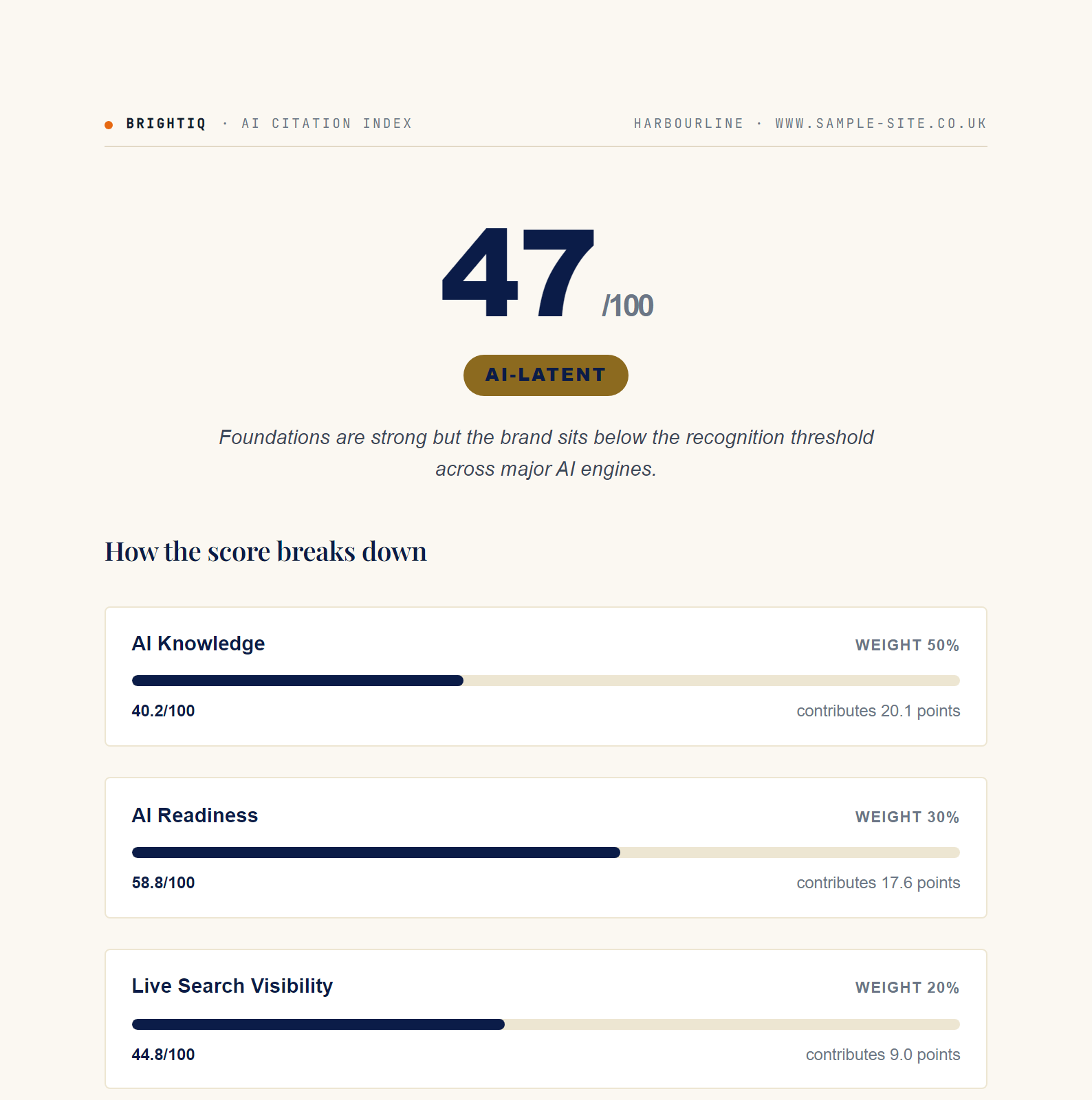
AI visibility is how often ChatGPT, Perplexity, Claude and Gemini name your business when someone asks. The assessment measures it against your competitors on the same questions. There are no real benchmarks yet, so a score on its own can flatter you.
I built this one-off assessment to show exactly how visible your website is to AI models, and whether they know your business.
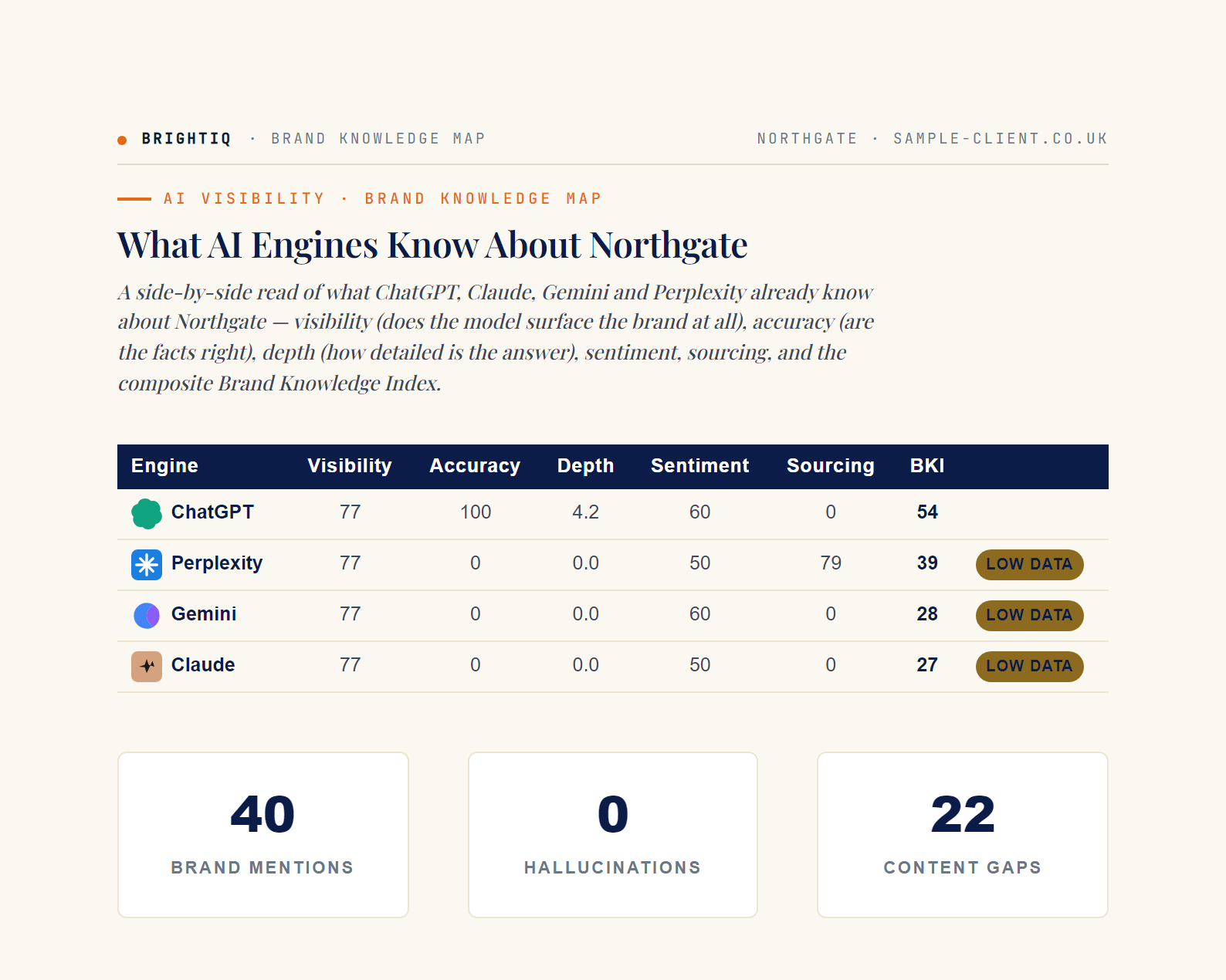
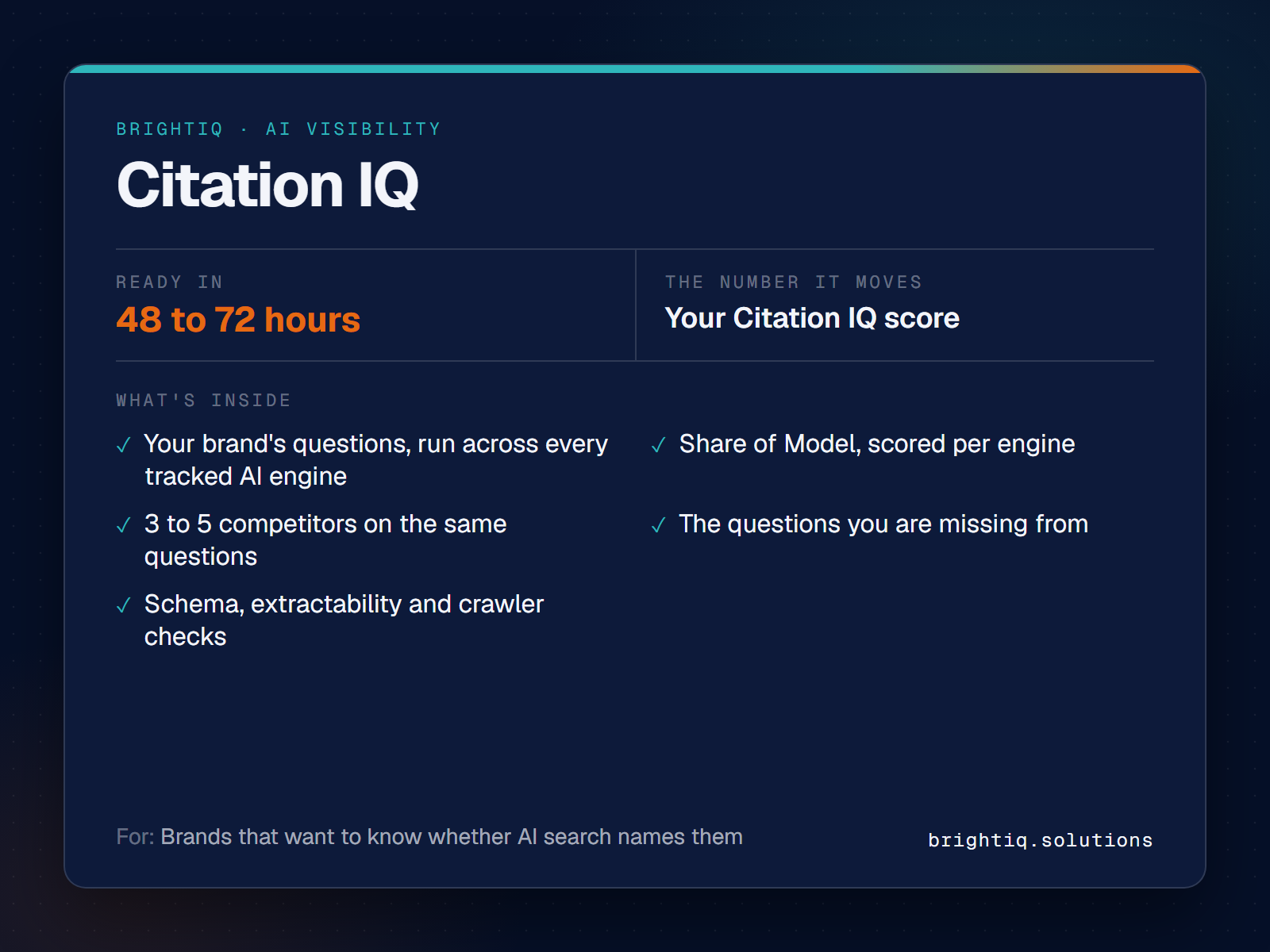
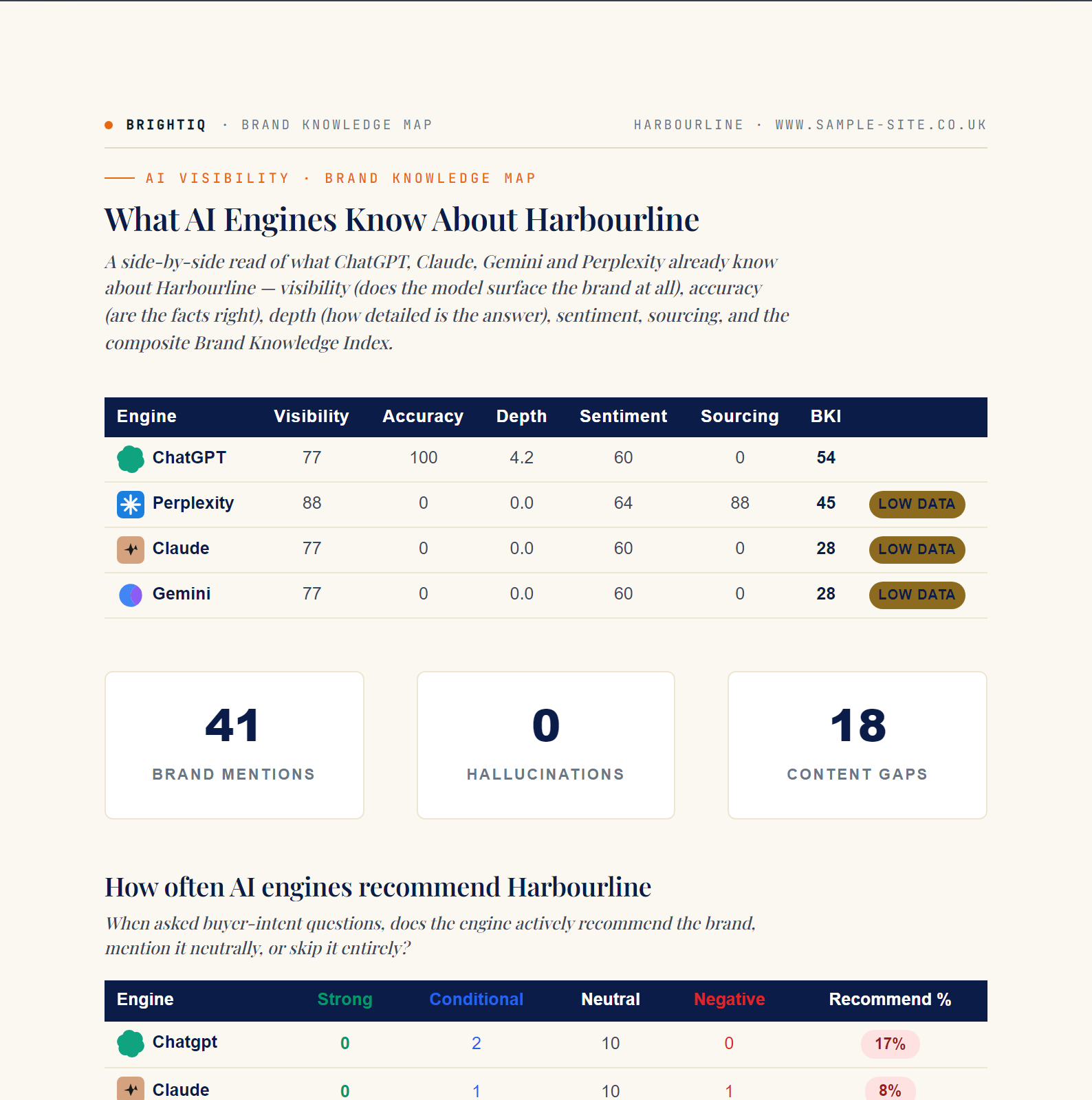
A Citation IQ is a one-off AI Visibility Assessment that measures whether AI engines name your brand when buyers ask about your category, and how often, relative to your competitors. It scores Share of Model per engine and overall, checks three to five competitors on the same queries, and reports the questions where your brand is absent entirely.
Citation IQ: how it works
How Citation IQ works, step by step: Query set, Every AI engine, Share of Model, Gaps and readiness, Branded report. Shown with a fictional demo brand.
How do you know whether AI is recommending you or your competitors?
Right now, nobody can see this channel. Your traffic and rankings show what happens on search results pages, but nothing in them shows whether an AI model names your business when a buyer asks about your category.
A buyer asks ChatGPT a question instead of typing a keyword into Google. The answer comes back naming three brands. If you are not one of them, there is no impression, no click and no line in any report to tell you it happened.
You cannot manage what nothing measures, and while you wait, a competitor may be named in your place. Citation IQ's AI Visibility Assessment gives you that reading as an extension of the SEO you already do.
You confirm the questions and competitors
Five steps take you from agreed questions to a ranked fix list. You confirm the questions and competitors up front, the system runs and scores the queries, and I sign off the final report.
Which buyer questions and rivals matter?
You confirm the competitor set and the questions your buyers really ask. I build the query set around them.
What do the engines actually say?
The system runs every query across each tracked AI engine and records the answers and the citations they give.
How often do you appear?
Code does the scoring, so the same answers always give the same result. Your brand and each competitor are scored on identical queries.
Where are you missing, and why?
The system flags weak citations and the questions where you are absent, then checks the site-side readiness behind them. I read the results and add my assessment.
What should you fix first?
I review the findings and sign off the branded report, with fixes ranked by their likely effect on your AI visibility.
One prioritised plan
The five steps combine into a single report, with each fix ranked by impact and attached to the evidence behind it.

What you get
Six deliverables, each tied to a decision you can make about how AI engines see your brand.
Brand-relevant query set across every tracked AI engine
You see the exact questions being put to these engines about your category, so you test the buyer moments that matter instead of guessing at them.
Share of Model per engine
You can see which engines name you and which ignore you, so you know where the first fix needs to go.
Overall Share of Model
You get one headline number to track over time, so you can tell whether your changes are moving you ahead of competitors.
Three to five competitors on identical queries
You see who is winning the same questions you are, so you know which rivals to beat and on which questions.
Gap analysis of unanswered questions
You get the specific questions where AI never mentions you, so you build content for demand you are missing rather than polishing pages nobody is asking about.
Site-side readiness (schema for AI, content extractability, crawler access)
You learn whether engines can read and parse your pages, so when something needs fixing you know whether the problem sits in your markup, your content or your crawl settings.
A plan you act on, not a list
Open it and the scores come first, then the evidence behind each fix. You can act on the top items without reading the rest.
The judgement sits with me. The system scores the answers but does not decide what they mean: I choose the fair competitors, which gaps matter for your category and the order of the fixes.
Your Share of Model scored per AI engine, 3 to 5 competitors on the same questions, and the questions you are missing from, back in 48 to 72 hours.
What changes after the assessment?
Within 48 to 72 hours of agreeing your questions and rivals, you hold a branded report showing how AI engines name your brand.
Your buyer questions and rival set are locked, and the engines have been queried against them.
Every answer is scored, and the questions where you are absent are logged for review.
You hold the reviewed report, with the first fix already picked out for you.
One agency I audited found its pages were not letting AI models index the content, so its scores were extremely low. After the fix, scores climbed and it began appearing in more searches, though it still has other technical issues to resolve.
How is this different from asking ChatGPT yourself?
| Asking ChatGPT yourself | Citation IQ | |
|---|---|---|
| Sample | One answer, on one day, from one account | A query set run per engine and scored as a pattern |
| Engines | One engine | Every tracked AI engine, scored per engine and overall |
| Competitors | Not compared | 3 to 5 competitors scored on the same questions |
| Gaps | You only see what you thought to ask | The questions your brand is absent from entirely |
| Your site | Not checked | Schema, extractability, crawler access and entity clarity reviewed |
A measurement of whether the AI engines name your brand, and how often, compared with the competitors you actually have.
Three ways to work together
One-off assessment
Your Share of Model measured once, with the gap list and site readiness review, back in 48 to 72 hours.
The Agency Plug-in
The assessment delivered white-label, so you hand it to a client under your own name.
The BrightIQ Engine: Grow
Monthly work that tracks Share of Model, deploys the fixes and reports on a set date.
Why trust me with this?
I'm Sebastian Beaton, and I built the audit engine. I have 17 years in SEO and now focus on AI visibility. The engine runs every query across 4 AI engines and scores Share of Model against named competitors, with code doing the scoring so results repeat. Across three monthly readings, my Share of Model rose from 84.6% to 88.9% against one competitor, with two zero-hallucination months in a row. I don't take on web design, paid ads, social media or team replacement. Nothing gets handed to a junior.
Who built this
Every system, every pipeline, every deliverable, built and maintained by one person.

Credentials
Experience
I built this because there was nothing on the market that let you have something created bespoke for your specific circumstances. It's built in a modular way and it's part of a larger audit system I built, so the variability and versatility of the audit is endless. It's bespoke for every website.
Why this matters
- ✓ I measure, I show the issues, and I set up the solution. Most tools stop at the first step; the whole point of this is that it does not.
- ✓ It measures instead of guessing. Asking ChatGPT once is one answer on one day; this runs a query set per engine and scores the pattern.
- ✓ Competitors are scored on the identical queries, so the comparison is real.
Frequently asked questions
Is this right for my website?
It is right if you run a small or medium-sized business and want to know whether AI engines name you, and how often, against your competitors. It suits owners who have no in-house SEO team to interpret the results.
Isn't this just SEO under a different name?
It is an extension of SEO, not a separate discipline. Search engines have been the traditional way sites get found, and this extends the same work so AI engines can also see and name your brand. Anyone selling it as something different is selling you something.
Do I need to run this again, or is one report enough?
One report gives you a baseline, but it will not stay accurate for long. Engines and their models keep changing, so the way this is measured has to change with them. Tracking is how you learn what moved your visibility and what did not. Plan to repeat it so the readings stay honest.
How do you make sure I only fix what matters?
Every fix is traced back to a specific question where your brand was absent or weakly cited. If a change does not connect to a question buyers actually ask, it does not make the list. I'd rather you act on a few well-chosen fixes than work through a long list of low-value ones.
How is this different from adding FAQ schema to my pages?
Schema is one input, and it is not the whole picture. Whether an engine can name you depends on how easily it can extract your content, how clearly it understands your entity, whether its bots can reach your pages, and how your brand is described across the web. I check all of them.
What happens if my brand does not show up at all?
That is a real result, and it is useful rather than a failure. The gap analysis lists every question where AI engines never mention you, so you can see exactly where the demand sits. From there, the fixes can target those questions first, so effort goes to buyers who are already asking.
Related services
Know exactly where you stand
You and I agree the buyer questions and rivals first, then I sign off a branded report with your fixes ranked, so you know what AI engines say about you and what to change first.
- Book a callSend your details and I reply within one working day.
- Scope agreedI confirm what you get and the delivery date before any work starts.
- DeliveredIn 48 to 72 hours, from the day I have access.