For online stores and agencies
The BrightIQ Ecommerce SEO Audit
Your whole catalogue checked
An ecommerce SEO audit that tells you what to fix. Most reports just tell you what's broken. This one gives you a document of what needs fixing, across your whole catalogue. Send me your web address and it's back in 48 to 72 hours.
I check your catalogue and document what needs fixing, not just what's broken, in a fix list you can work through.
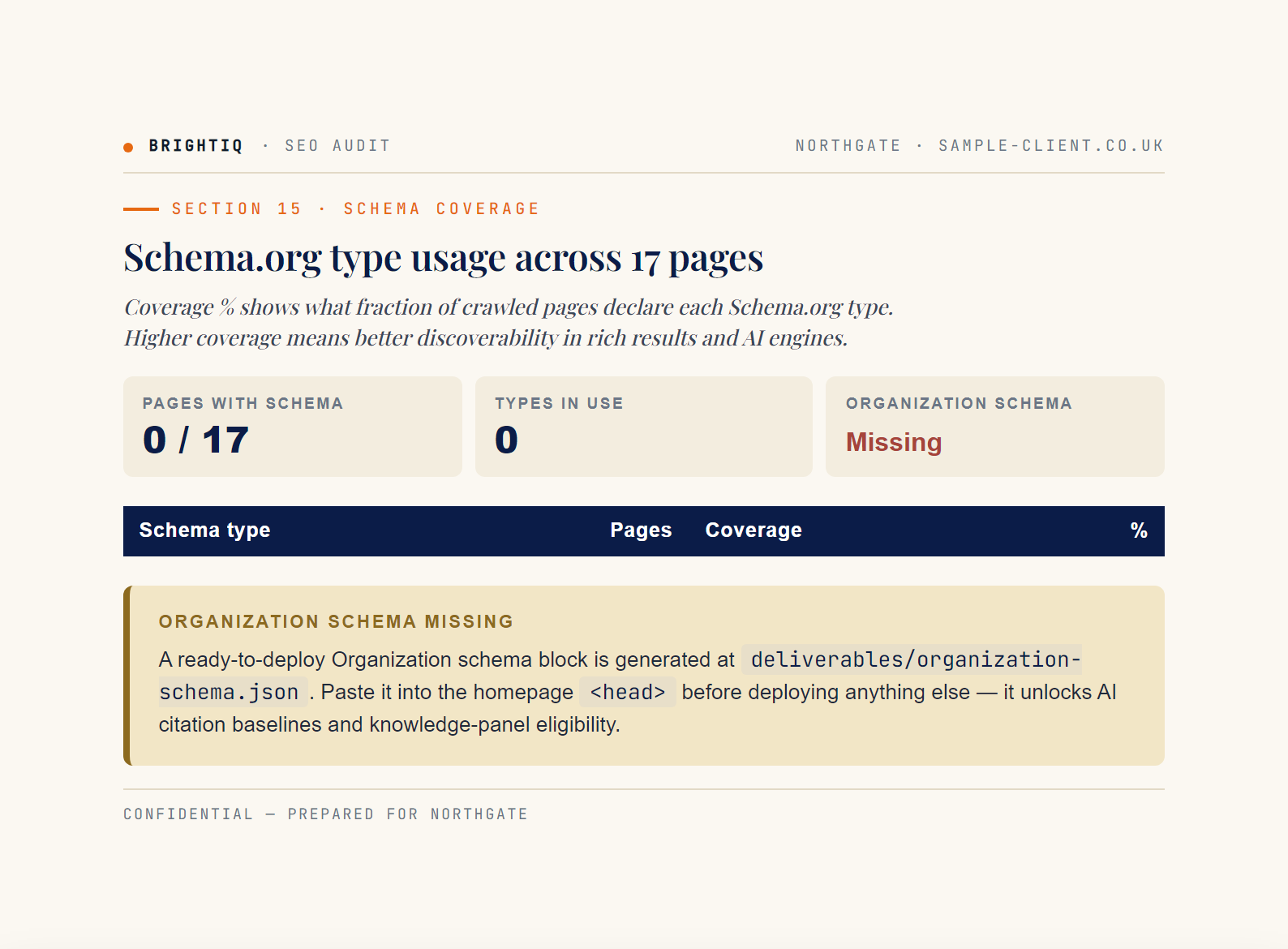
A BrightIQ Ecommerce SEO Audit is a bespoke review of an online store's catalogue that documents what is broken and what needs fixing, covering product schema validation, category architecture, faceted navigation, filter URL handling, thin and duplicate manufacturer content, crawl budget and orphaned products.
How an ecommerce SEO audit works: one real job
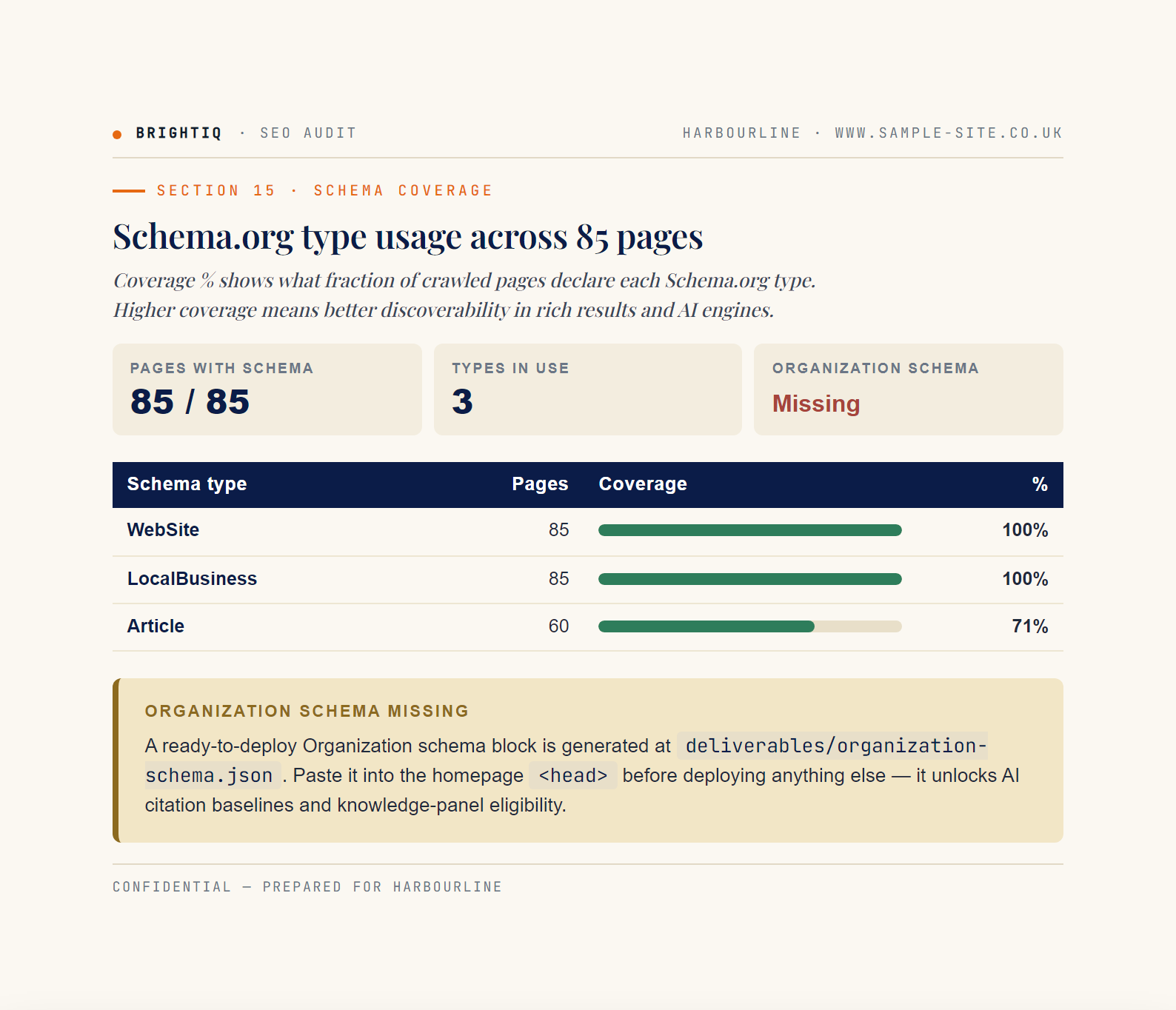
Follow one real audit of a UK online shop, anonymised: every page crawled in a real browser, findings ranked, checked against the live site, and false findings taken out before the client sees them.
Is your catalogue quietly costing you sales?
You run an online store, and the catalogue is the asset that earns or loses you money. Most audits sample a handful of pages and hand back a long list of flagged issues with no sense of which ones matter.
The things that cost a store money are catalogue-shaped: products nothing links to, filters spawning near-duplicate URLs, manufacturer copy repeated across every competitor. Most flagged issues will never move your traffic, yet they arrive with the same weight as the ones that will.
Staying as you are means hours on the wrong fixes while the ones that matter wait. I built this audit to give you a documented fix list, ranked by impact, that also covers content, E-E-A-T and internal linking, which fixed-path audits skip.
Five stages from data to deliverables
Five stages, run in order, turn your site data into verified findings. Each stage hands its output to the next, so nothing reaches you unchecked.
What do we need to know first?
You send Search Console access and any existing docs. I compile them and your business context into a brief before anything is crawled.
What does every page look like?
The system crawls the pages in scope, using a real browser so JavaScript-rendered sections appear as the crawler sees them.
Which findings matter most?
The rules engine runs first, then the judgement checks, with a validator between them. Each finding is scored and graded.
Are the findings right?
I run two QA passes. The technical pass checks data quality (pages, scores, orphans, false positives). The SEO pass checks findings are correct and the industry context fits.
What do you take away?
The system builds the report, a URL-by-URL issues spreadsheet, an action tracker and deployable schema files. I sign off before you receive them.
One verified audit pack
The steps combine into a single report, issues spreadsheet, action tracker and schema files, each mapped to the URLs it affects.

What you get
What lands is a catalogue audit with a fix list you can act on: six deliverables covering product pages, category structure, and how search engines crawl your store.
Product schema validation per product page
You know which product pages have missing or broken markup, so you can fix them in one pass instead of hunting through the catalogue.
Category architecture
You see how your categories nest and where they are too shallow or too deep, so you can fix the structure rather than guess at it.
Faceted navigation
You see which filter combinations create pages search engines can reach, so you can decide which to keep and which to stop.
Filter URL handling
Every filter URL is assessed, so you can stop search engines spending time on near-identical pages.
Duplicate manufacturer content flagged at scale
Every product description copied from the manufacturer is flagged across the catalogue, so you know which pages to rewrite first.
Crawl budget
You see which URLs waste crawl budget, such as filter combinations and near-duplicates, so you can close them off.
A fix list you can execute, not just read
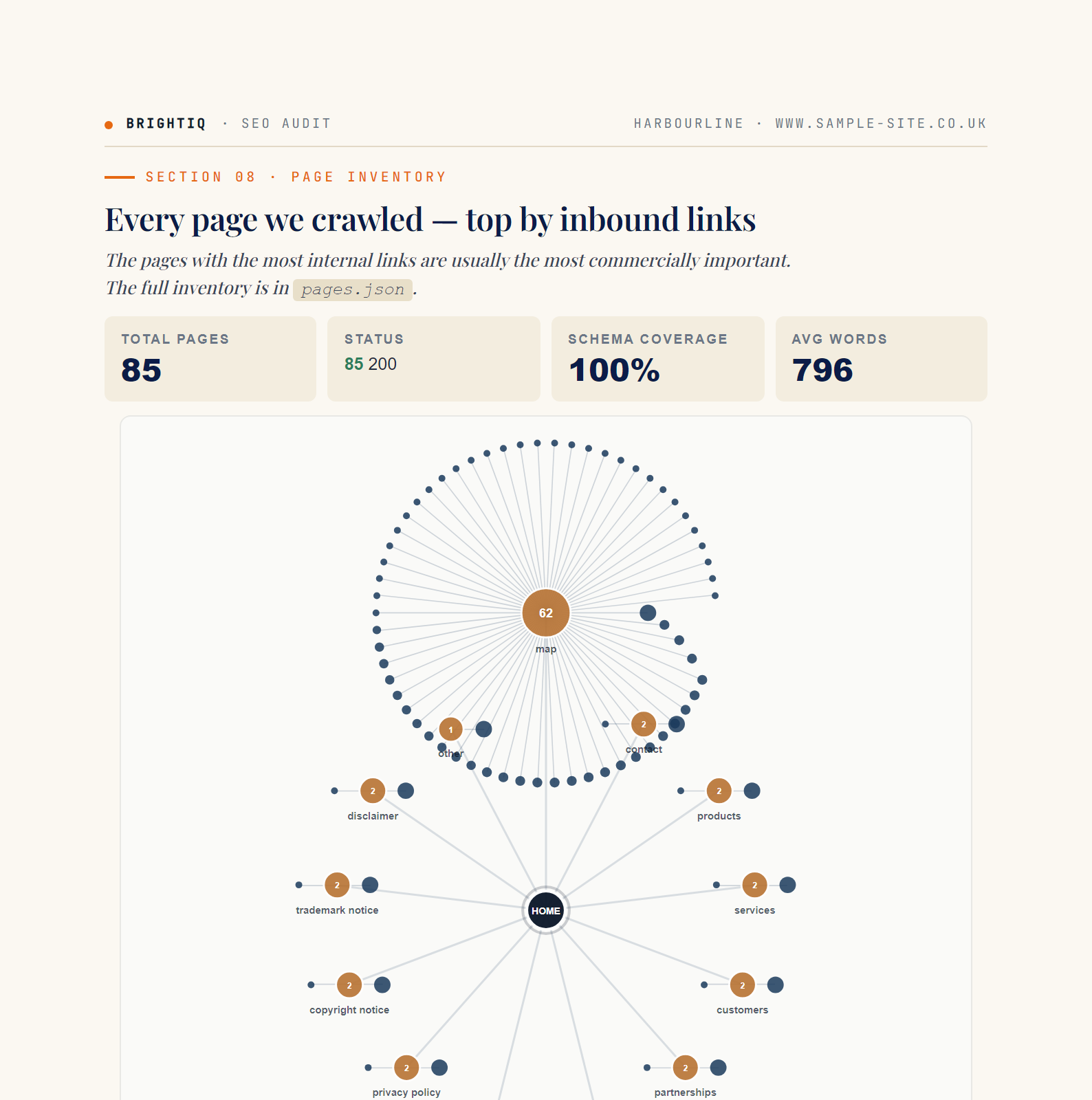
The main deliverable is a fix list, not a list of faults. Each item says what to change and in what order, so you can work through it.
The judgement is mine. I decide which problems will move your traffic and which can wait, because the same issue can hurt one store and do nothing for another.
A prioritised fix list covering product schema, category structure, filter URLs and duplicate manufacturer copy, back in 48 to 72 hours.
What changes after the audit?
Within 48 to 72 hours, you have a finished audit of your full catalogue: every issue found, ranked by impact, and a clear order to fix them in.
I crawl every product, category and filter URL, and check the product schema on each page.
I work through the findings, flagging thin and duplicate manufacturer content, orphaned products and weak internal links across the catalogue.
You receive the written audit: a prioritised fix list, page-by-page findings and the order I'd tackle them in.
That's the point of it: a structured way to fix things, not just a list.
How is this different from a generic site audit?
| A generic site audit | The BrightIQ Ecommerce SEO Audit | |
|---|---|---|
| What it checks | A website | The catalogue: products, categories and filters |
| Coverage | A sample of pages | Every page crawled, no cap |
| Manufacturer copy | Not flagged at scale | Duplicate copy flagged across the catalogue |
| Priority | Equal weight to every flag | Ranked by what will move traffic |
| Output | What is broken | What to fix, in order, in language you can use |
A bespoke, modular audit. You choose what it looks at, and it tells you exactly what is wrong in language you can actually use.
Three ways to work together
One-off audit
A single catalogue audit with the prioritised fix list, back in 48 to 72 hours.
The Agency Plug-in
The audit under your agency's brand, written to the depth your client needs.
Ecommerce SEO automation
Take the fix list a step further: I have the automations to fix some of those problems at catalogue scale.
Why trust me with this?
I'm Sebastian Beaton, and I built the audit engine myself. I have 17 years in SEO and run every system myself. Most audits sample a handful of pages and weight every flag equally, so fixes that won't move traffic sit beside the ones that will. I crawl every catalogue page with no cap, flag duplicate manufacturer copy, and rank fixes by traffic impact. My largest full-site crawl covered 1,040 of 1,061 pages (98%). I don't offer web design and development, paid ads, social media or team replacement.
Who built this
Every system, every pipeline, every deliverable, built and maintained by one person.

Credentials
Experience
I built the audit system to run this way because almost every other audit I have ever had runs in one specific way, so you get the same output structure for every website you put in. They also generally never answer how to fix it. That is left up to whoever is doing the audit. This system lets me create a bespoke audit that fits your requirements and is written in a way you understand. That is the whole point of it. It gives you the opportunity to see what is wrong and to fix what is wrong, in a way you understand.
Why this matters
- ✓ Modular, not fixed-path. You choose what it looks at, so what comes back is bespoke to your site and written in a way you can actually understand.
- ✓ One document, every reader. A developer works from the spreadsheets and fixes the problems; a marketer uses the report to explain the issues. Nobody needs it translated first.
- ✓ Findings are ranked, not listed. Most issues an audit flags will not move traffic, and this separates the ones that will.
Frequently asked questions
Is this right for my website?
Yes, if you run an online store, or an agency serving one, and the catalogue is the asset that matters. The fix list is written to be carried out, not just read. Hundreds or thousands of product pages is exactly the situation this was built for.
How do you make sure I only fix what matters?
Every issue is ranked by how much it is likely to affect traffic, so you can see the handful of high-priority fixes first. Most audits give every flagged item equal weight, which wastes time on problems that will never move your visitors. Ranking that separates the two is the point of the report.
Can you audit a large catalogue without sampling a few pages?
Yes. Sampling twenty pages of a five-thousand product store tells you nothing, so I crawl the full site and choose the depth of each area separately. My largest full-site crawl covered 1,040 of 1,061 pages, 98%.
Will the audit be built for my store, or is it the same template every time?
It is built for your store. Most audits run one fixed path, so you get the same output for every website. Mine lets me pre-select the areas that matter for your site, such as usability, content, technical and AI visibility, and build the report around them.
Can the report be read by both my developers and my marketing team?
Yes. Every report is written in technical or non-technical language, so your developers get the detail they need and your marketing team gets the same findings in plain terms. The report draws on 26 composable sections, and you choose which ones go in.
Who actually does the work?
I do. I have 17 years of SEO behind the audit, and one person builds and runs every system behind it, so you deal with the same person throughout. That also means I can answer questions about any finding directly.
Related services
Know exactly where your catalogue stands
When you book a call, I'll walk you through what the audit covers and what you'll know once it's done: where your whole catalogue stands and which fixes matter first.
- Book a callSend your details and I reply within one working day.
- Scope agreedI confirm what you get and the delivery date before any work starts.
- DeliveredIn 48 to 72 hours, from the day I have access.