For WooCommerce stores and agencies
WooCommerce SEO automation
Store content written at scale
WooCommerce SEO services that write the content your store needs for every product, category and variant, with product schema through the SEO plugin you already use. Each page starts from the live one, because that's where what's unique to the product already sits. Scoped before I start.
I write titles, descriptions and product copy for every product, variant and category, and the schema runs through the SEO plugin you already use.
A WooCommerce SEO Automation is a service that writes a store's search content at scale: meta titles and descriptions for every product and category, unique copy for every SKU and variant, and product schema generated through the SEO plugin you already run. Every job begins with a store audit, and every job is scoped before work starts.
How BrightIQ writes product pages, followed on one real job
One real job of 73 new garden machinery products, anonymised: facts read from the source, each page written in steps, checked, reviewed by Sam and delivered ready to import.
Is your catalogue outgrowing its upkeep?
WooCommerce gives you flexibility but demands maintenance. Every product, variant and category needs its metadata looked after, and that is the first thing to slip. New products arrive with thin copy, and it stays that way.
As the catalogue grows, metadata goes untouched, category archives sit empty and variants share the same description. Each gap looks minor, but they stack up. Search engines read each page alone, so shared variant copy gives you weak pages.
A store with thousands of products cannot rely on hand-written titles and descriptions, so the gaps compound. The usual reflex is another plugin, but plugins fight each other and none of them write your copy. I write the metadata, product copy and schema for the whole catalogue, and it imports into your existing setup.
Agree the scope, then receive finished copy
Four stages, run in order: I audit the store, you and I agree the scope, the content gets written and checked, then the files come to you.
Where does the store lose search visibility?
I audit products, categories, duplicate content and plugin setup for SEO gaps. You get the findings in one written report.
What gets fixed first, and when?
You and I go through the findings together and agree the order and timing before any writing begins.
How is every page's copy checked?
The system writes every product, variant and category, metadata included, and I review each piece against the source.
What do you load into your store?
I hand over the import file and schema, built to load into your SEO plugin.
One checked catalogue
Each step builds on the last, so the store ends with audited, scoped and verified copy.

What you get
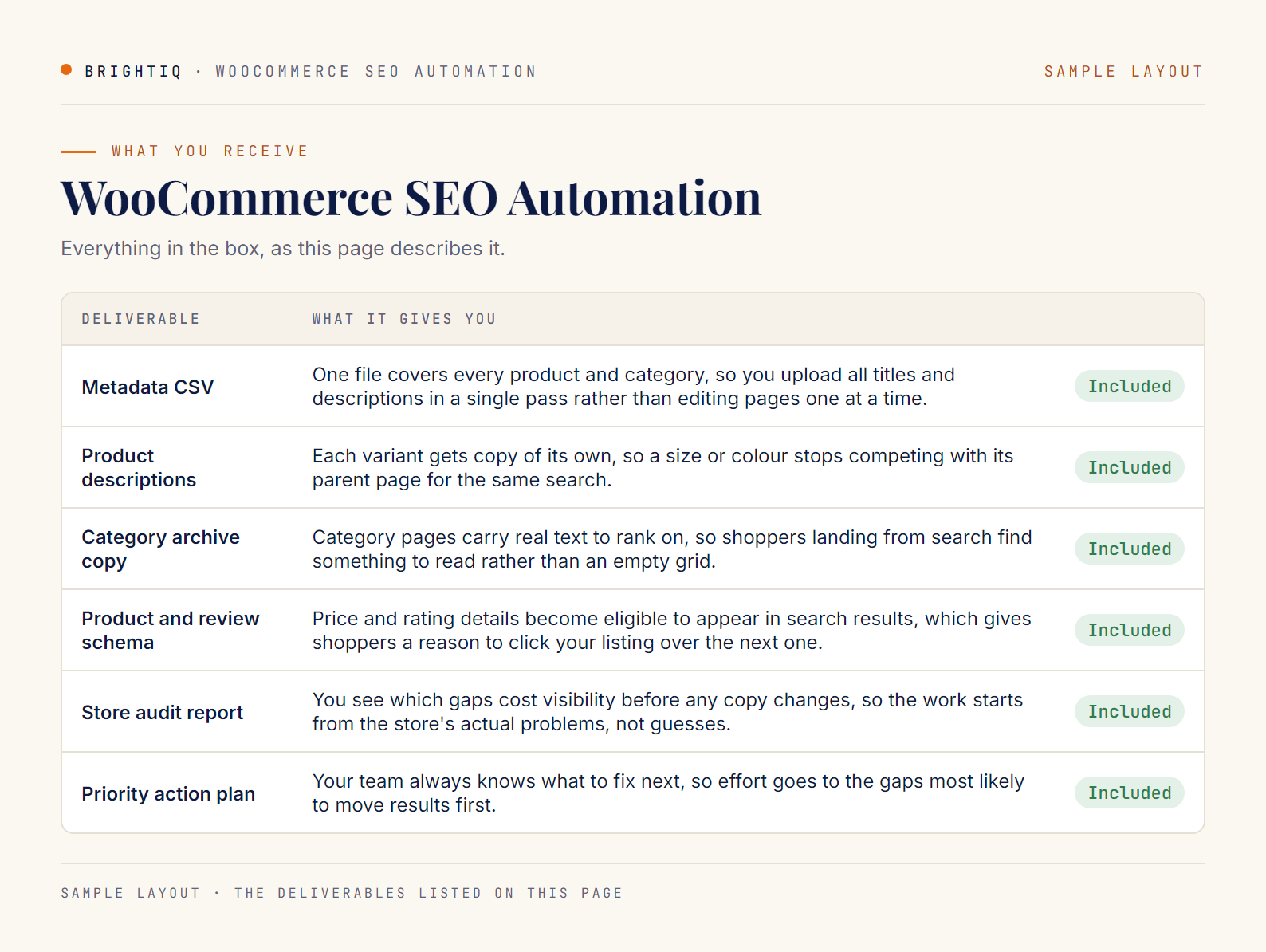
Six deliverables, each aimed at a specific gap in your store's search presence.
Metadata CSV
One file covers every product and category, so you upload all titles and descriptions in a single pass rather than editing pages one at a time.
Product descriptions
Each variant gets copy of its own, so a size or colour stops competing with its parent page for the same search.
Category archive copy
Category pages carry real text to rank on, so shoppers landing from search find something to read rather than an empty grid.
Product and review schema
Price and rating details become eligible to appear in search results, which gives shoppers a reason to click your listing over the next one.
Store audit report
You see which gaps cost visibility before any copy changes, so the work starts from the store's actual problems, not guesses.
Priority action plan
Your team always knows what to fix next, so effort goes to the gaps most likely to move results first.
A plan you work down, one fix at a time
The action plan is one document, with issues listed in the order they are likely to matter. You start at the top and work down. Each entry names the pages it affects, so nothing needs translating.
The order is my call, not the tool's. I decide which gaps matter most for your store and which can wait.
A metadata CSV to import, descriptions for every SKU and variant, product and review schema, and a store audit, timed and scoped before I start.
What changes after the store audit?
You hold a timed, agreed scope before any copy is written. The turnaround is scoped per engagement, so the dates are set once I have seen your catalogue.
You and I agree the scope and the order of fixes, and the dates go into writing.
I write to the agreed order, and you can check progress against the plan at any point.
You receive the import files, the schema and the action plan, with the dates you agreed.
Once the handover is done, your search content is written, checked and ready to load, and the next gap is already ranked. Your team can work down the list in order without needing me to decide what comes next.
How is this different from your SEO plugin's templates?
| Your SEO plugin's templates | WooCommerce SEO Automation | |
|---|---|---|
| Titles and descriptions | One variable pattern across the store | Written from each product's specs and searches |
| Variants | Share one description | Each variant written on its own |
| Category archives | Left empty | Copy for every category page |
| Facts | Pulled from fields as they are | Checked against the source, nothing invented |
| Store audit | None | A store audit before work starts |
It works with your existing plugin setup, not against it.
Three ways to work together
A five-page introductory sample
Five of your products written first, so you can read the difference before the full job.
Full store job
Products, variants, categories, metadata and schema across the store, timed and scoped before I start.
White-label for agencies
The same work for your WooCommerce clients, under your agency's brand.
Why trust me with this?
I'm Sebastian Beaton, and I've spent 17 years in SEO writing product copy myself, not handing it to a junior. Each product is read from its specs, its live page and the searches buyers actually use, and every variant gets copy of its own. I don't take on web design, paid ads, social media or team replacement.
Who built this
Every system, every pipeline, every deliverable, built and maintained by one person.

Credentials
Experience
I built it because WooCommerce gives you flexibility but demands maintenance. Plugin conflicts and inconsistent SEO settings compound as a catalogue grows, and writing metadata by hand stops being possible. It works with your existing plugin setup, not against it.
Why this matters
- ✓ Works with your existing SEO plugin, with no extra plugin added.
- ✓ Every product read first: the specs, the live page and buyer searches.
- ✓ Unique copy for every SKU and variant, and content for empty category archives.
Frequently asked questions
Is this right for my website?
Yes, if your store has more products than anyone can write titles and descriptions for by hand, or variants sharing one description. If your catalogue is small enough to edit yourself, you may not need it. The store audit shows which applies before you commit to anything.
Will the copy sound like my brand rather than a template?
Yes. I read each product from its specs, its live page and the searches buyers actually use, so the copy describes what you really sell. Nothing reaches you until I have checked it against that source, so the wording is one I would stand behind.
How do you make sure I only fix what matters?
The store audit ranks every gap by likely impact, and the priority action plan lists them in that order. Pages already earning impressions or sitting just off page one usually come first, because small gains there show soonest. I make the call on order, and you can challenge it before any writing starts.
Do I need to add another plugin to make this work?
No. The schema and the metadata import through the SEO plugin you already run, so there is nothing new to install or keep in sync. Adding a plugin to fix an SEO gap usually creates a second place where settings can conflict, and it still leaves the product copy unwritten.
What results have you seen from a metadata rewrite?
That period ran during a Google core update, so the rewrite was not the only factor. Results depend on the store and its starting point.
Can I keep the copy and edit it myself afterwards?
Yes. You receive the files to load, edit or pass to your team, so the copy stays under your control. Nothing in the setup locks you to me once the handover is done.
Related services
Know exactly where your store stands
Book a call and you and I agree what the store audit should cover, so you leave the first conversation with a clear picture of what is worth fixing.
- Book a callSend your details and I reply within one working day.
- Scope agreedI confirm what you get and the delivery date before any work starts.
- DeliveredWooCommerce SEO Automation is delivered on the date agreed with you.