For agencies and ecommerce blogs
An SEO content writer built on research
The Content Engine
A long-form article in clean Markdown, the SERP and gap brief behind it, and its title, meta and link suggestions, first batch back in 48 hours.
I research what already ranks for your keyword, then write each article to beat it, with its title, meta description and link suggestions.
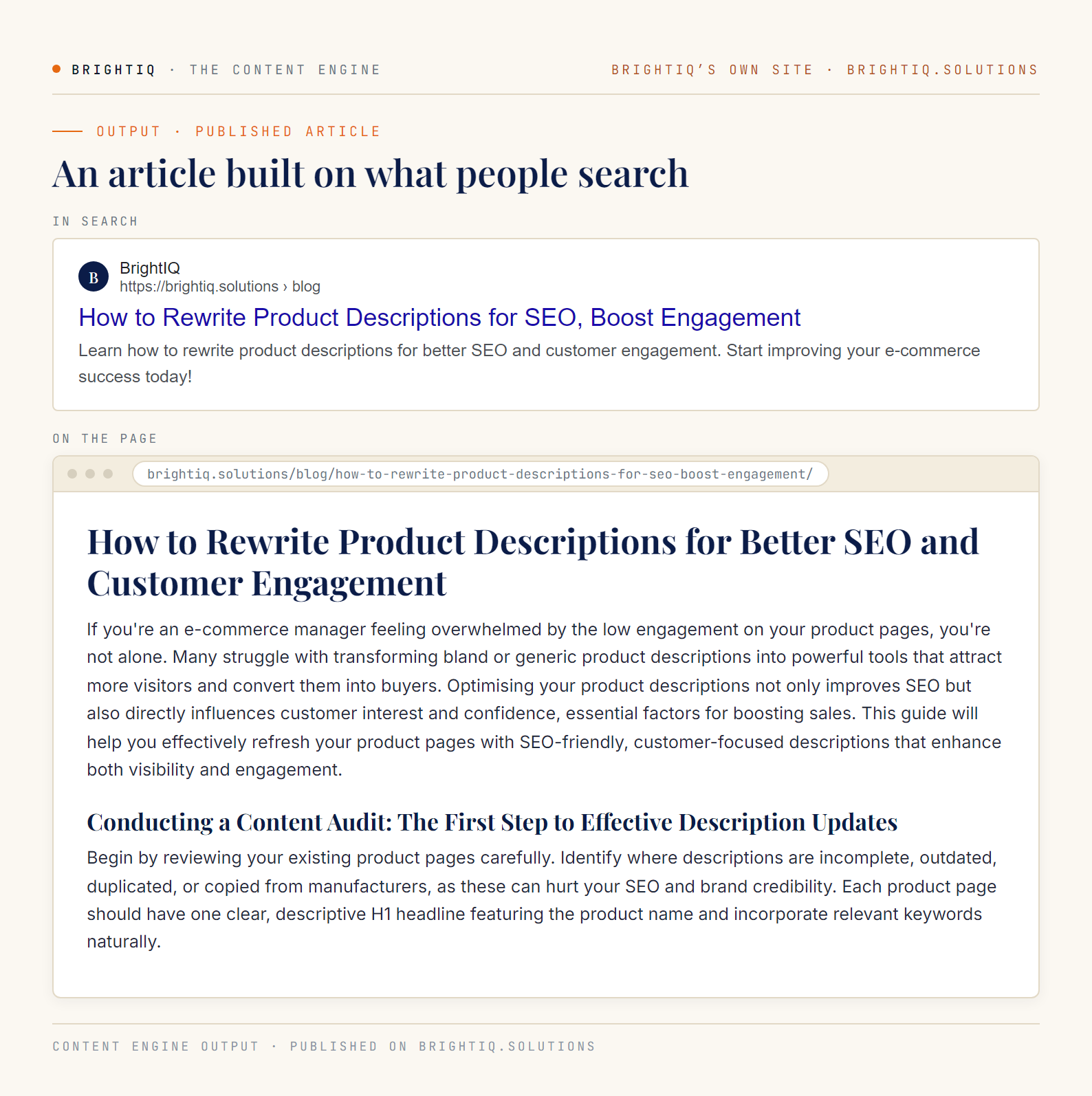
The Content Engine is a research-first article service that examines what already ranks for a keyword, maps its entities and subtopics and the gaps those pages leave, and delivers a structured Markdown article with a title, meta description, and internal link suggestions.
How the BrightIQ content writer works, on one real glossary
One real job of glossary and term pages for a UK cyber security consultancy, anonymised: the subject mapped, a plan, every page in one format, and Sam checking the drafts and the live pages.
Why does your new article read well and still not rank?
You commission or write a new article for a search you actually want to win. It reads well, the headings look sensible, and it goes live. Then it sits on page three, or nowhere, while the pages above it keep taking the clicks.
The usual mistake is assuming that asking a model for an article gives you content. It gives you words. Without research first, the draft is fluent, generic and padded, with no idea what the pages it has to beat actually cover.
Staying with that draft costs you the search it was written for. Meanwhile, the pages that did the research keep the traffic. The Content Engine reads what already ranks, maps the entities and gaps those pages leave, and I write to that brief.
Four steps from keyword to publish
You supply the topic, the system does the research and drafting, and I review the output before it reaches you.
What do you want to rank for?
You supply the target keyword, the page it supports, and any angle or audience you want.
What is the search really asking?
The live results and ranking pages are read for coverage, gaps, entities and the intent behind the search.
How does the article get written?
A structured article is written to the brief in your voice, with headings, internal links and schema. I review it before it reaches you.
What is left before publishing?
You get the article, the research, the metadata and a flag log. Confirm any sources, then publish.
One publish-ready article
Each step builds on the last, so the topic, research, draft and checks combine into an article you can publish once the flagged sources are confirmed.
What you get
Each article arrives with the research behind it and the pieces needed to publish, so you review a finished draft rather than start from a prompt.
Structured long-form article
you get a draft in clean Markdown that you can review and publish without first rebuilding its structure.
SERP and gap brief
you see what the ranking pages cover and miss, so the article is built to beat them rather than repeat them.
Entity and subtopic map
you can confirm the article covers the entities and subtopics the topic needs, so the piece has depth rather than surface coverage.
Title and meta description
the search listing is sized to fit the results page, so it isn't cut off before someone decides to click.
Internal link suggestions
you know which pages on your site the article should link to, so you add those links in minutes rather than hunting for them.
Flag log
every claim that needs a source confirmed is listed before you publish, so an unverified statement doesn't go live by accident.
A draft you can check and publish, not a guess
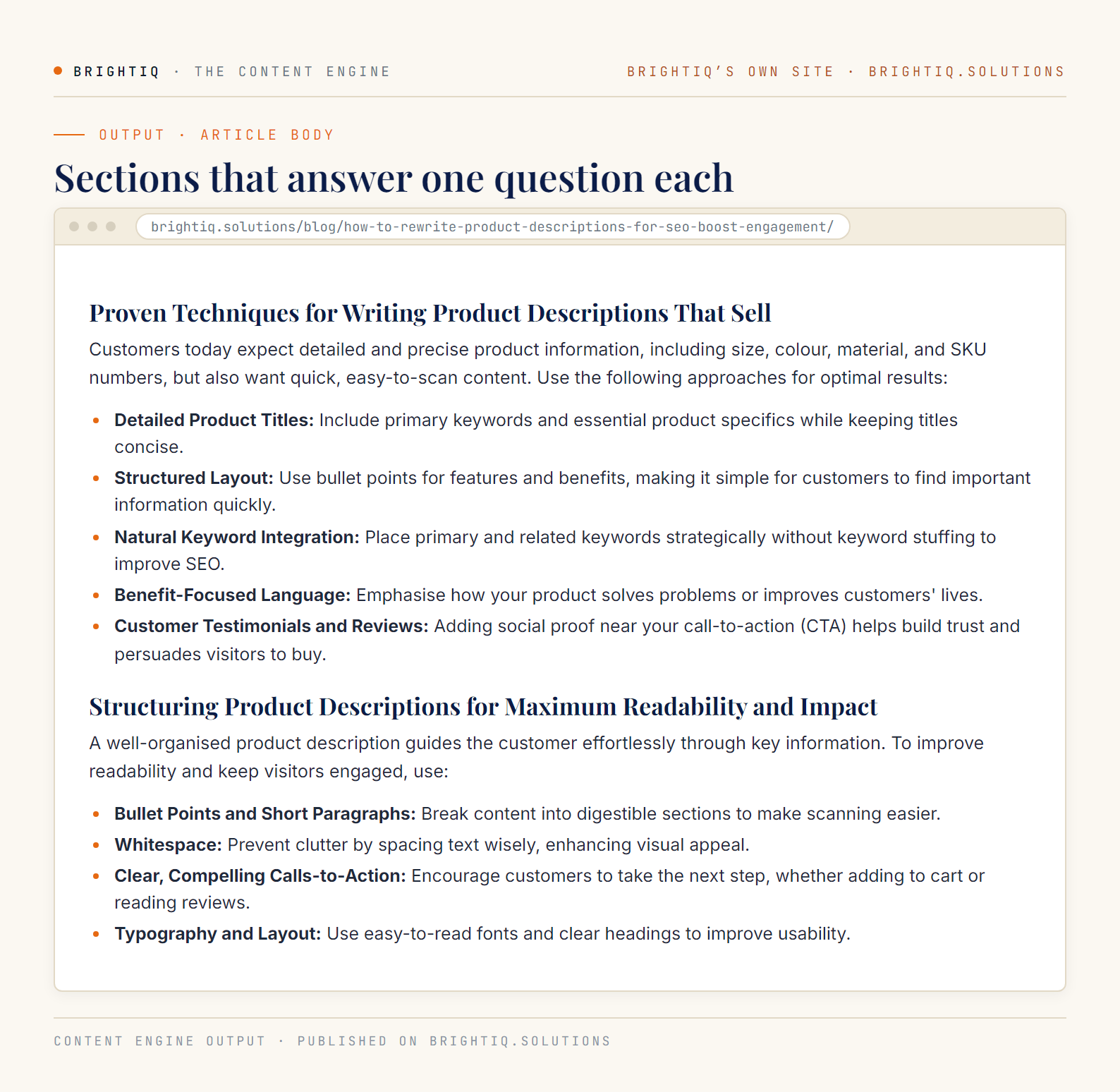
The article arrives as clean Markdown, structured and ready to read as a finished draft. You work through it the way you would a colleague's draft, with the flag log open beside it.
Judgement sits with me, not the draft. I decide whether each claim holds, whether the angle fits your business, and whether the piece is worth publishing.
A long-form article in clean Markdown, the SERP and gap brief behind it, and its title, meta and link suggestions, first batch back in 48 hours.
What changes after the Content Engine?
I send you the SERP and gap brief, a long-form article in clean Markdown, and its title, meta and link suggestions. The first batch is back within 48 hours.
I start from your brief and pull the search results and content gaps for your target keyword.
The SERP and gap brief is with you, so you can check the angle before the article is drafted.
The first batch lands: a long-form article in clean Markdown, plus title, meta and link suggestions, ready for your review.
Your team spends its time reviewing and editing rather than starting from a blank page. Each article arrives with the research behind it, so you can see why every section is there before you approve it.
How is this different from a generic AI writer?
| A generic AI writer | The Content Engine | |
|---|---|---|
| Before writing | A prompt, nothing else | The live results and ranking pages read first |
| The brief | None | A research-led brief: intent, structure, gaps |
| Topic coverage | Whatever the model reaches for | The entities and subtopics the ranking pages cover |
| Length | An arbitrary word count | What the topic and competing pages call for |
| Unsourced claims | Written in | Flagged for you to confirm |
The research drives the brief, so the article is built to rank rather than just fill a page.
Three ways to work together
A batch of articles
Articles for the keywords you want to win, each with its research, first batch back in 48 hours.
White-label for agencies
Articles for your clients under your agency's brand, with the research behind each one.
Custom build
A content system built around your own workflow and voice, which you own.
Why trust me with this?
I'm Sebastian Beaton, and I research each Content Engine article before writing it. I have 17 years in SEO, and a model asked for an article gives you words, not content. So I read pages ranking for your keyword, map their entities and build a brief from the gaps. A glossary programme I ran lifted section clicks from 6 to 37 in three months. I do it all myself, nothing handed to a junior. I don't do web design and development, PPC, social media or team replacement; narrowing to one job is why the work ships right.
Who built this
Every system, every pipeline, every deliverable, built and maintained by one person.

Credentials
Experience
I built it to be information dense and to avoid the AI slop trap. Generic AI writing has no idea what is already ranking. Research runs before any writing, so the article is built to compete with the pages that rank, not padded with the phrasing a model reaches for by default.
Why this matters
- ✓ Research before writing: the live results and the pages already ranking are read first.
- ✓ A research-led brief before any writing: intent, structure, entities and the gaps to fill.
- ✓ Entity and subtopic coverage, so the article covers the full topic, not a thin slice.
Frequently asked questions
Is this right for my website?
Yes, if you need new articles to win specific searches, or if you're an agency producing content for clients who won't accept copy that reads like a prompt. If you already have posts slipping, the blog updater is the better fit, and I'll say so on a call.
How do you make sure the article doesn't read like a prompt answer?
Research runs before any writing. I read what already ranks for your keyword, map the entities and subtopics those pages cover, and find the gaps they leave. The brief comes from that, so the article is built to compete with those pages rather than padded to a word count.
Why not just ask an AI tool for the article myself?
You can, and you'll get words. What you won't get is an article that knows what is already ranking. A plain prompt produces fluent, generic copy with no view of the pages it has to beat, so it tends to skip the subtopics the topic needs. My process starts with that research.
How do you handle claims I can't verify before publishing?
Every claim that needs a source confirmed goes into a flag log delivered with the article. You check those flags before anything goes live, so nothing unverified reaches your readers by accident. I'd rather you check a short list of flags than publish a number nobody can source.
Who actually checks the article before I see it?
I do. I build and run every system myself, so the person who writes the brief is the one checking the draft against it. That keeps the feedback loop short, and it means the article answers the brief you agreed.
Will the article rank as soon as it's published?
I can't promise a position, and anyone who does is guessing. What I can show you is the gap the brief is built to close, the entities the page must cover, and the pages it has to beat. Ranking depends on competition and time, so judge it against that brief, not against a guarantee.
Related services
Know Whether the Content Engine Fits Your Site
On the call I'll go through what you publish, who you're writing for, and where the research fits. You'll leave knowing whether the Content Engine suits your site.
- Book a callPick a time that suits you.
- Scope agreedI confirm what you get and the delivery date before any work starts.
- DeliveredFirst batch back in 48 hours, from the day I have access.