For SMEs with manual processes
Business process automation for SMEs
The Workflow Build
Business process automation for UK SMEs. I take the jobs that eat the most time, such as invoicing, onboarding and approvals, and build them into systems that run. I start with the longest job, because that's where you get the time back fastest. Timing and scope are agreed before I start.
I find the processes wasting the most time and build the systems that run them: invoicing, onboarding, approvals, data entry and reporting.
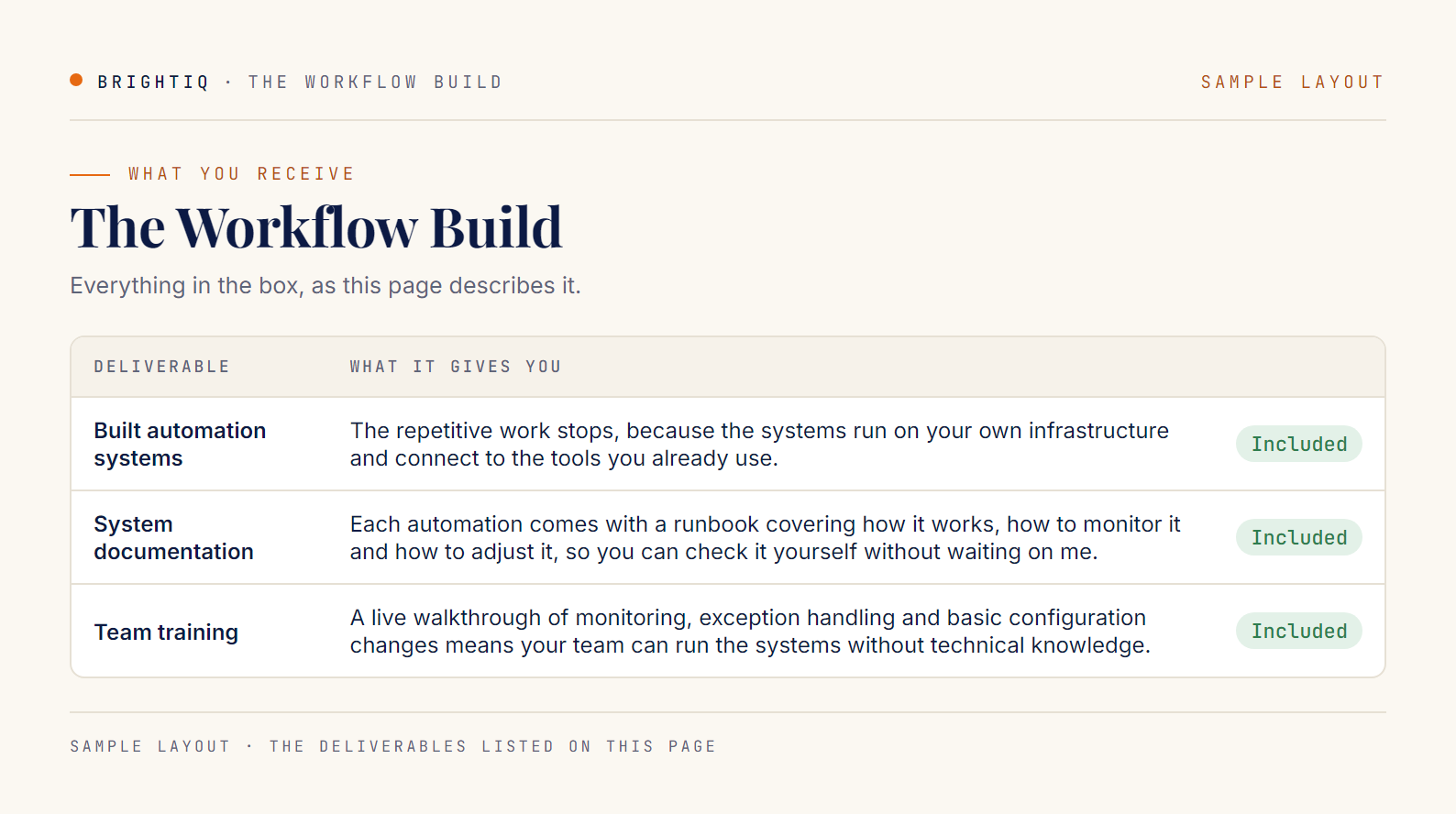
The Workflow Build is a done-for-you automation service that identifies your highest-impact manual processes and builds live systems to run them on your own infrastructure, connected to the tools you already use. Each system ships with a runbook and a handover walkthrough for your team.
How Business Automation works
The steps of the service: your processes mapped and the costliest found first, each one automated around how you work, documented with a fallback or a check, then handed to your team to run, so the hours go back to work that grows the business.
Is your team still doing by hand what a system should handle?
Most small businesses know which jobs eat their week: invoicing, onboarding, approvals, and copying data between spreadsheets. The awareness is there. What holds people back is unclear procedures and uncertainty about which technology is safe to rely on.
Work that follows the same rules every time is exactly what a system should handle, yet it keeps landing on the same people. Every new client adds another form, sign-off and report rebuilt by hand.
Staying as you are keeps the same tasks eating your week. Most people make the mistake of trying to transform everything at once. I start with the process that wastes the most time and has the clearest rules, then build the system with a runbook and hand it to your team.
Four steps from audit to running systems
Each step builds on the one before: the audit finds the work, the ranking decides what matters, the build delivers it, and handover leaves your team in control.
Where does your team's time go?
I map your core processes with your team and measure the time spent on manual, repetitive tasks.
Which processes should we automate first?
I score each process for automation potential, time saved, error reduction and complexity.
What gets built first?
I build and test the top-priority automations, quick wins first and complex systems second.
Can your team run it without me?
I train your team with a live walkthrough, document each automation and support you as you maintain and extend them.
A ranked, tested set of automations your team owns
The ones you get are the most worth building, documented and running on your own infrastructure.

What you get
Every Workflow Build ends with three things in your hands: working automations, a runbook for each one, and a training session that gets your team running them.
Built automation systems
The repetitive work stops, because the systems run on your own infrastructure and connect to the tools you already use.
System documentation
Each automation comes with a runbook covering how it works, how to monitor it and how to adjust it, so you can check it yourself without waiting on me.
Handover walkthrough
A walkthrough at handover of monitoring, exception handling and basic configuration changes means your team can run the systems without technical knowledge.
A system you can check and adjust yourself
Each runbook opens with what the automation does, then shows where to look when something seems wrong and how to change a rule without touching code.
The judgement stays with you: which process goes first, and when a rule has changed enough to update. The systems carry out the steps; you set the direction.
Your top repetitive processes, such as invoicing, onboarding or approvals, built into systems that run, documented and handed over to your team, timed and scoped before I start.
What changes after the Workflow Build?
You get your top repetitive processes built into systems that run on their own, documented and handed over to your team. The timing is scoped and agreed with you before the build starts.
I agree in writing which processes to automate, the scope of each one, and the timing, before any build begins.
I build each process into a working system and test it against your real invoices, onboarding steps or approvals.
You receive the running systems, step-by-step documentation, and a walkthrough so your team can run them without me.
Your team stops re-keying the same information and chasing the same sign-offs. Each process runs the same way every time, and you can see where it stands without asking someone to check.
How is this different from doing it by hand?
| Doing it by hand | The Workflow Build | |
|---|---|---|
| Invoicing and payments | Raised and chased by hand | Example: invoicing and payment chasing |
| Client onboarding | Documents collected one email at a time | Example: an onboarding sequence that collects the documents |
| Approvals | Chased through inboxes | Example: approvals routed for expenses, content and milestones |
| Data entry | Retyped from forms | Example: forms that flow into your CRM or accounting |
| Reporting | Built by hand each time | Example: scheduled reports, with alerts when thresholds are hit |
Free your people from what a system can do the same way every time.
Three ways to work together
The Automation Audit
I map your processes and rank the top opportunities by return before anything is built.
The Workflow Build
Your top-priority automations built, documented and handed over with team training.
Ongoing support, scoped with you
I build the systems and keep them configured, maintained and running on your behalf each month.
Why trust me with this?
I'm Sebastian Beaton, and I build each system myself. I start with the process that wastes the most time and has the clearest rules, automate one thing, measure the impact, then scale. Each system runs on your infrastructure with a runbook, and your team gets training on monitoring and basic adjustments, not code. I don't do web design, paid ads, social media or replacing your team.
Who built this
Every system, every pipeline, every deliverable, built and maintained by one person.

Credentials
Experience
Most SMEs know which processes waste time. Unclear procedures and uncertainty about technology keep them stuck doing them by hand. That is the problem I solve: I find the highest-impact opportunities and build the systems, so you get results, not just a strategy deck.
Why this matters
- ✓ Quick wins first, complex systems second.
- ✓ Connected to the tools you already use, agreed at scoping.
- ✓ A runbook for every automation, written for non-technical staff.
Frequently asked questions
Is this right for my business?
Yes, if you are a UK SME that already knows which processes waste your time but still handles them by hand. Invoicing, client onboarding, approvals, data entry, reporting, scheduling and communications are good candidates, as long as the work follows rules you can state. If you have not identified those processes, I start there.
How do you make sure I only automate what saves real time?
I start with the one process that wastes the most time and has the clearest rules, then automate one or two things and measure the impact before going further. Transforming everything at once is the mistake I see most often, and it stalls before anything saves time. Only then do I scale.
Can my team run these automations without a technical background?
Yes. I build systems your team can use without technical knowledge, and training covers monitoring and basic adjustments rather than code. Each automation also comes with a runbook explaining how it works, how to monitor it and how to adjust it.
What happens if an automation breaks after handover?
Your team handles routine exceptions using the monitoring and adjustment steps from training, and each runbook shows where to look first. Anything beyond that comes to me, because I build every system and there is no handover to a third party. A fault becomes a known, documented procedure, not an emergency.
How will I know the automation is actually saving time?
You know through a before-and-after measurement. Before building, I record how long the process takes and how often it runs. After go-live, the same measurement shows whether the time saved is real. If the numbers do not move, I change the rules or scope rather than assume the build worked.
How is this different from hiring a consultant to write a strategy?
I build the working system rather than hand you a plan. A strategy document tells you what to fix, then the work stays on your list. I identify the highest-impact opportunities and build them myself, so you get live invoicing, onboarding, approvals or reporting on your infrastructure, with a runbook for each.
Related services
Know whether automation fits your business
When you book, I walk through which manual process costs you the most time, and you leave knowing whether a Workflow Build is the right fit.
- Book a callSend your details and I reply within one working day.
- Scope agreedI confirm what you get and the delivery date before any work starts.
- Built for youThe Workflow Build is built for your business, on the date agreed with you.