For agencies pitching new business
The BrightIQ Prospect Audit
Walk into the pitch prepared
An SEO prospect audit is the scorecard you take into a first meeting, showing a new client what's wrong with their site before you've started. It's designed to get your foot through the door. Send me their web address and it's back in 24 to 48 hours.
I built this bespoke audit for agencies and consultants to run before a first prospect meeting. The report fits how the prospect thinks.
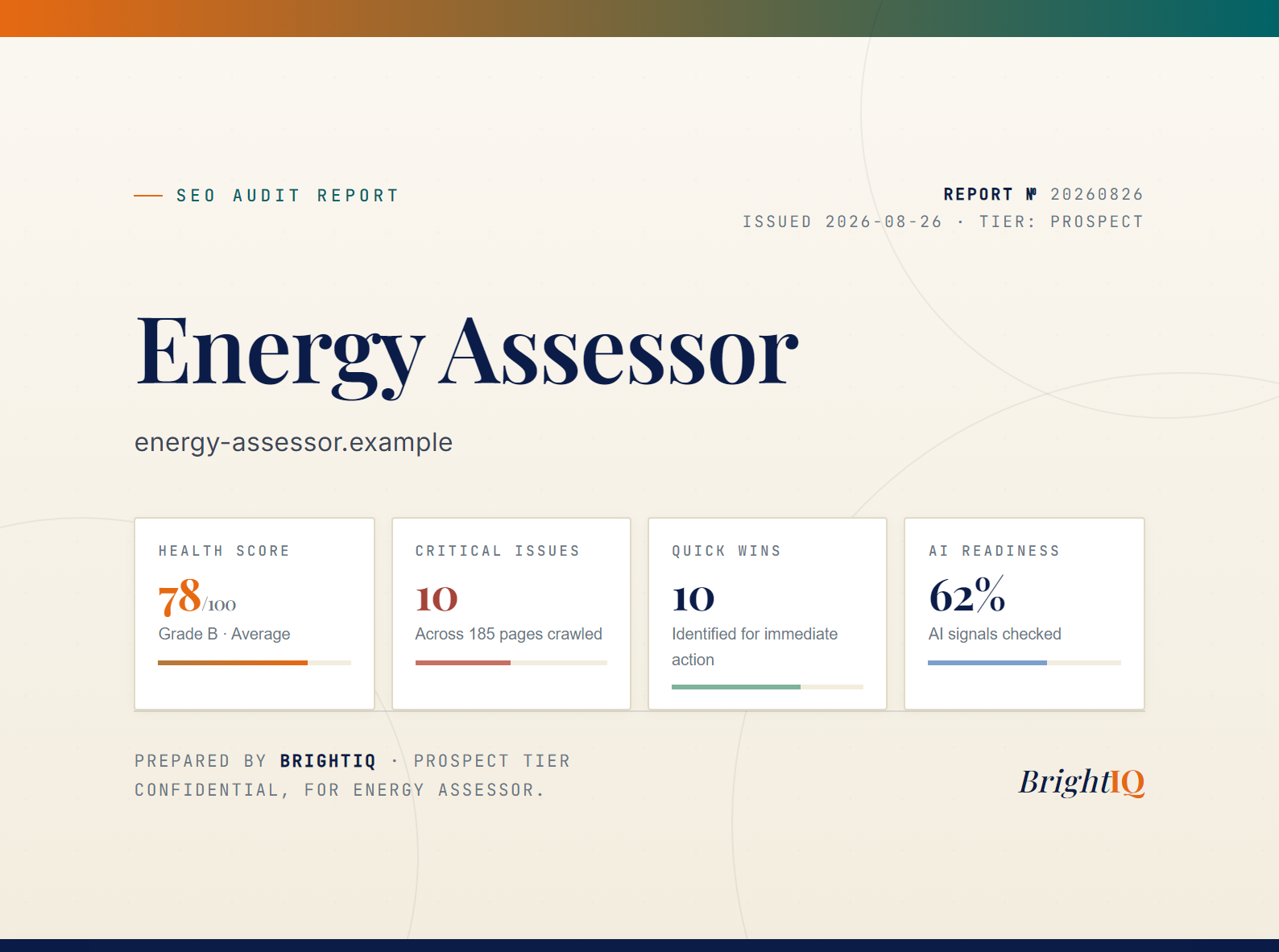
A BrightIQ Prospect Audit is a bespoke diagnostic report that examines a prospect's website before any engagement begins, showing what is wrong and how to fix it. It delivers a health score, a category breakdown, the top five critical issues with affected URLs, and five to seven quick wins ranked by effort and impact.
How a BrightIQ prospect audit works, on one real cold lead
One real prospect audit of an energy-assessment firm, anonymised: from a web address alone to every page crawled, the five pages that matter, Nora and Sam checking the work, and the pack for the first meeting.
Walking into a pitch with nothing to show?
You are sitting across from a prospect who wants proof. Your pitch runs on assertion, so they cannot tell you apart from the next agency. A Screaming Frog export is not a document you can hand over.
Most prospects have run a free check, so they expect a report and usually get a long list of flags. Few of those flags will move traffic, and the output never says which ones will. Tool-generated audits also skip whole areas, such as writing quality and E-E-A-T.
A full audit costs more than the pitch is worth at this stage, so you skip it and stay vague. I built the BrightIQ Prospect Audit to fix that.
From your data to a signed-off report
Five steps run in order. I compile your data into a brief, the system crawls every page and scores it, then I check the results twice before you receive the deliverables.
What is already known about the site?
You supply Search Console access, existing documents and business context. I turn them into a brief before any crawl starts.
Has every page been seen as the crawler sees it?
The system crawls the pages in scope, using a real browser so JavaScript-rendered pages are included.
How are the findings graded?
The rules engine runs first, then the judgement checks, with a validator between them to catch errors.
Are the findings accurate before you see them?
I run both passes myself. The technical pass checks data quality (pages, scores, orphans, false positives); the SEO pass confirms the findings are correct and the industry context fits.
What do you get to act on?
The system produces the report, an issues spreadsheet mapped URL by URL, an action tracker and deployable schema files. I sign off before release.
One verified set of findings
Your data, the full crawl and two QA passes combine into deliverables you can act on, with each issue mapped to its URL.

What you get
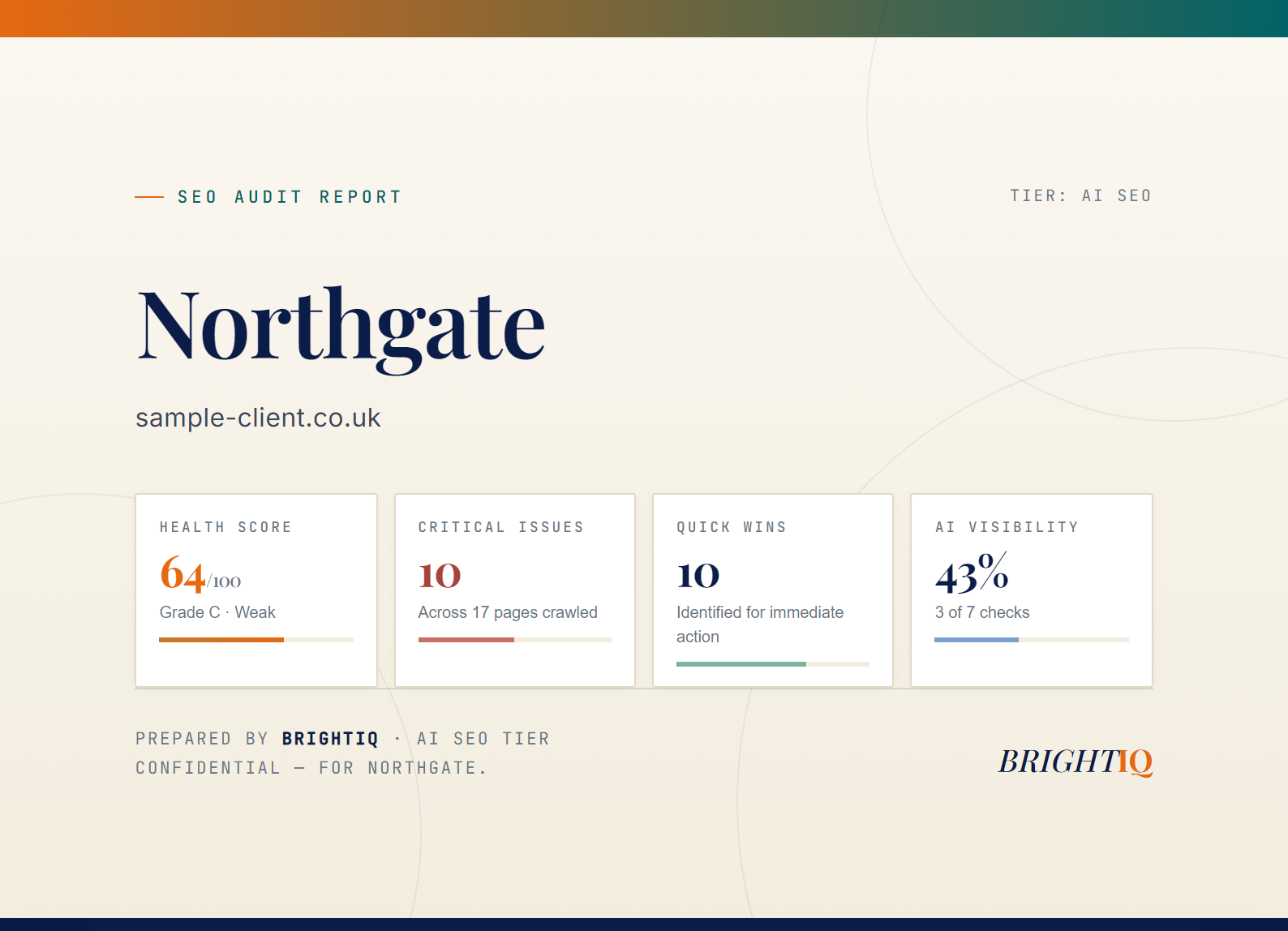
Here is what you get from the Prospect Audit: a single health score, the five issues that matter most, and a plan you can put in front of a prospect.
Health score
You can show a prospect where their site stands in one number, so the conversation starts from evidence rather than guesswork.
Top 5 critical issues with affected URLs
You know exactly which pages to point to in the meeting and which problems to raise first.
5-7 quick wins with effort and impact
You can see which fixes are cheap and high-impact, so you never have to argue about where to start.
On-page deep dive on 5 priority pages
You can walk the prospect through how their key pages read and where they lose ground, page by page.
Page quality ratings
You can say which pages are weak on quality and explain why, instead of relying on a hunch.
30/60/90 roadmap
The prospect gets a dated plan for the first three months, which makes the next step a proposal you can write straight away.
A plan you act on, not a list you drown in
The report is built for the prospect in front of you. Technical buyers get technical detail, visual buyers get visuals, and every issue comes with its affected URLs.
I rank the findings, since most flagged problems won't move traffic. You choose the focus areas before the audit runs, and you decide what to raise in the room.
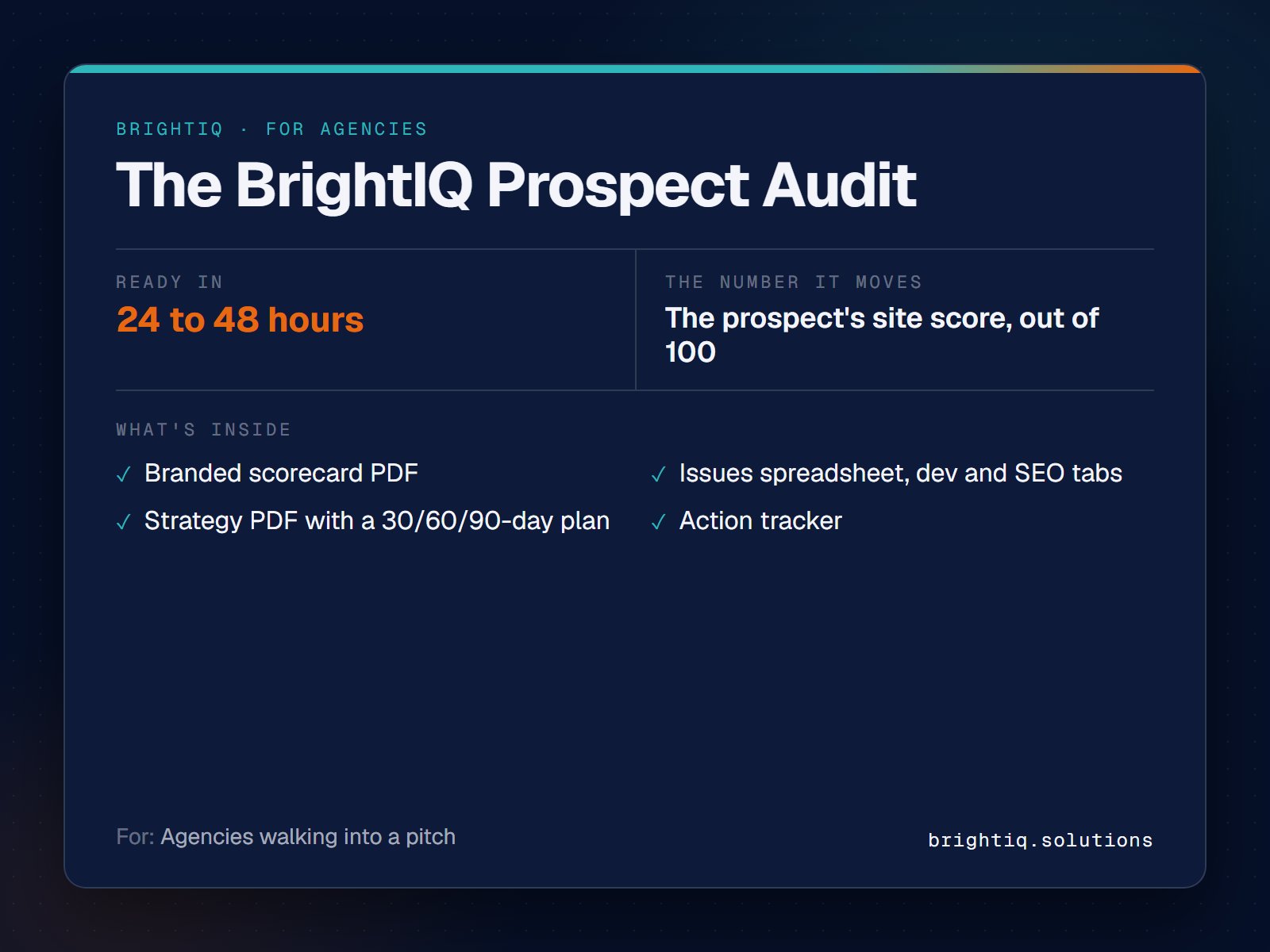
A branded scorecard, an issues spreadsheet with dev and SEO tabs, and a strategy PDF with a 30/60/90-day plan, back in 24 to 48 hours.
What changes after the BrightIQ Prospect Audit?
Within 24 to 48 hours of my having the URL, you have a branded scorecard you can put in front of any prospect: a health score, the top five critical issues, quick wins and a 30/60/90 roadmap.
I crawl your prospect's site, score it and review the priority pages.
I finish the on-page deep dive and assemble the scorecard under your agency's branding.
You hold a finished scorecard you can send to a prospect the same day.
That's what the audit is for: a structured way to actually fix things, not just a list.
How is this different from a crawler export?
| A crawler export | The BrightIQ Prospect Audit | |
|---|---|---|
| In the pitch | A spreadsheet of warnings, no priority order | A branded scorecard in your agency's identity |
| Structure | Same output structure for every site | Matched to the prospect: technical or visual |
| Priority | Equal weight to everything | The handful that will move traffic, separated from the noise |
| Readers | One artefact aimed at one job title | Developer works from the spreadsheets, marketer explains from the report |
| Accuracy | False positives left in | Human-checked before you see it |
A bespoke, modular audit. You choose what it looks at, and it tells you exactly what is wrong in language you can actually use.
Three ways to work together
One-off pitch pack
Send the URL, get the branded scorecard set back in 24 to 48 hours.
Pitch packs in bulk
Send several URLs at once, each scorecard priced per deliverable.
Upgrade into the full audit
Prospect converts? Everything gathered feeds the full AI SEO Audit. Nothing is wasted.
Why trust me with this?
I'm Sebastian Beaton, and I built the audit engine myself after 17 years in SEO. Most audits run one fixed path and rarely say how to fix what they find. Mine is bespoke, technical or non-technical, built from 26 composable report sections. On the largest full-site crawl I have run, 1,040 of 1,061 pages (98%) were covered. One person builds and runs every system, so you get a report and a plan you can act on. I don't do web design, PPC, social media or team replacement.
Who built this
Every system, every pipeline, every deliverable, built and maintained by one person.

Credentials
Experience
I built the audit system to run this way because almost every other audit I have ever had runs in one specific way, so you get the same output structure for every website you put in. They also generally never answer how to fix it. That is left up to whoever is doing the audit. This system lets me create a bespoke audit that fits your requirements and is written in a way you understand. That is the whole point of it. It gives you the opportunity to see what is wrong and to fix what is wrong, in a way you understand.
Why this matters
- ✓ Modular, not fixed-path. You choose what it looks at, so what comes back is bespoke to your site and written in a way you can actually understand.
- ✓ One document, every reader. A developer works from the spreadsheets and fixes the problems; a marketer uses the report to explain the issues. Nobody needs it translated first.
- ✓ Findings are ranked, not listed. Most issues an audit flags will not move traffic, and this separates the ones that will.
Frequently asked questions
Can the report match my prospect's level, technical or visual?
Yes. Every report is written either technical or non-technical, so a developer gets the detail and a marketing director gets plain English. Crawl depth and report depth are chosen separately, so the prospect sees what suits them. I build it around the person in the room, not a fixed template.
What exactly does my prospect see in the scorecard?
They get a health score and a category breakdown, then the top five critical issues with the affected URLs. Next come five to seven quick wins, each with effort and impact noted, plus an on-page deep dive on five priority pages. The pack closes with page quality ratings and a 30/60/90 day roadmap.
What happens to the data if the prospect signs?
The audit becomes the starting point for the work if they sign. The 30/60/90 roadmap they have already seen becomes the plan, and the findings on each priority page carry straight into the first actions, so nothing gets rediscovered.
Is this right for my agency or consultancy?
Yes, if you are an agency or consultant pitching new business in the UK and want something concrete in the room at the first meeting. It shows a prospect what is wrong with their site and how you would fix it, before any engagement exists.
How do you make sure I only fix what matters?
I rank every issue by likely impact, so you only fix what is likely to matter. The top five critical issues come with their affected URLs, and the quick wins show effort against impact. Most flags won't shift traffic on their own, and this stops you spending time on them.
What makes this different from a standard audit?
I build each audit around the site and the prospect rather than a fixed path. Standard audits give the same output structure whatever the site, and rarely say how to fix anything. You choose the areas, usability, content, technical or AI visibility, and the fixes come written in a way you understand.
Related services
Know exactly where you stand
Book a call and I'll walk you through what the audit would cover for your business, so you know what you'll get before anything is committed.
- Book a callSend your details and I reply within one working day.
- Scope agreedI confirm what you get and the delivery date before any work starts.
- DeliveredIn 24 to 48 hours, from the day I have access.