Bulk Meta Automation
Titles, Descriptions, and Content at Scale
Every agency has the same dirty secret with large ecommerce clients: the metadata is templated. "{Product Name} | Buy Online | {Brand}" repeated across a thousand pages. It ranks for nothing specific and compels nobody to click. The difference is per-page analysis. I analyse each page individually — product name, category, attributes, competitor keywords — and generate metadata that targets specific buying terms for every single page. Per-page AI analysis produces better, more unique metadata than a human writing their 500th title tag on a Friday afternoon. 1,000 pages. Unique meta for every one. 24 hours, not 4 weeks. From £297.

5 Key Highlights on Bulk Meta Automation
1,000 Pages in 24 Hours
Unique title tags, descriptions, and H1s delivered as an import-ready CSV, replacing weeks of manual writing
Per-Page Keyword Targeting
Each page analysed for product attributes, category context, and competitor terms so every title targets a specific search query
Zero Duplicate Metadata
Automated quality checks catch identical or near-identical titles before delivery, eliminating the duplicate content flags templated meta creates
Fixed Pricing from £297
Up to 250 pages for £297, 1,000 for £497, 5,000 for £797, so you budget with certainty before starting
Same Quality on Page 1,000
The system does not fatigue, cut corners, or write filler at 4pm on a Thursday
When Bulk Meta Automation Delivers Maximum Value
Bulk meta automation delivers the most value when your current process is costing more than it should.
- ✓ You have an ecommerce client with 500+ product pages and templated metadata. The site ranks for generic brand terms but misses thousands of specific buying keywords. Manual rewriting would take a senior SEO three to six weeks and cost £5,000–£10,000 in staff time.
- ✓ You are onboarding a new client and the metadata is a mess. Duplicate titles, missing descriptions, H1s that say "Welcome" on every page. Rather than spending the first month fixing metadata, get it done in a day and move straight to strategy work that actually grows the account.
- ✓ A client is launching a new product range or seasonal collection. Every new range means another 100–500 pages needing unique metadata. With fixed pricing and 24-hour turnaround, new ranges get proper metadata the same week they launch — not three months later when someone finally gets round to it.
- ✓ Your team writes good meta but cannot justify the hours at scale. 30–50 pages per day is realistic for quality metadata. At that rate, a 1,000-page project blocks a team member for a month. This frees that person for work that requires human judgement — content strategy, link building, client communication — while the metadata gets handled overnight.
What You Get with Bulk Meta Automation
Bulk meta automation delivers four clear outputs in a single import-ready package.
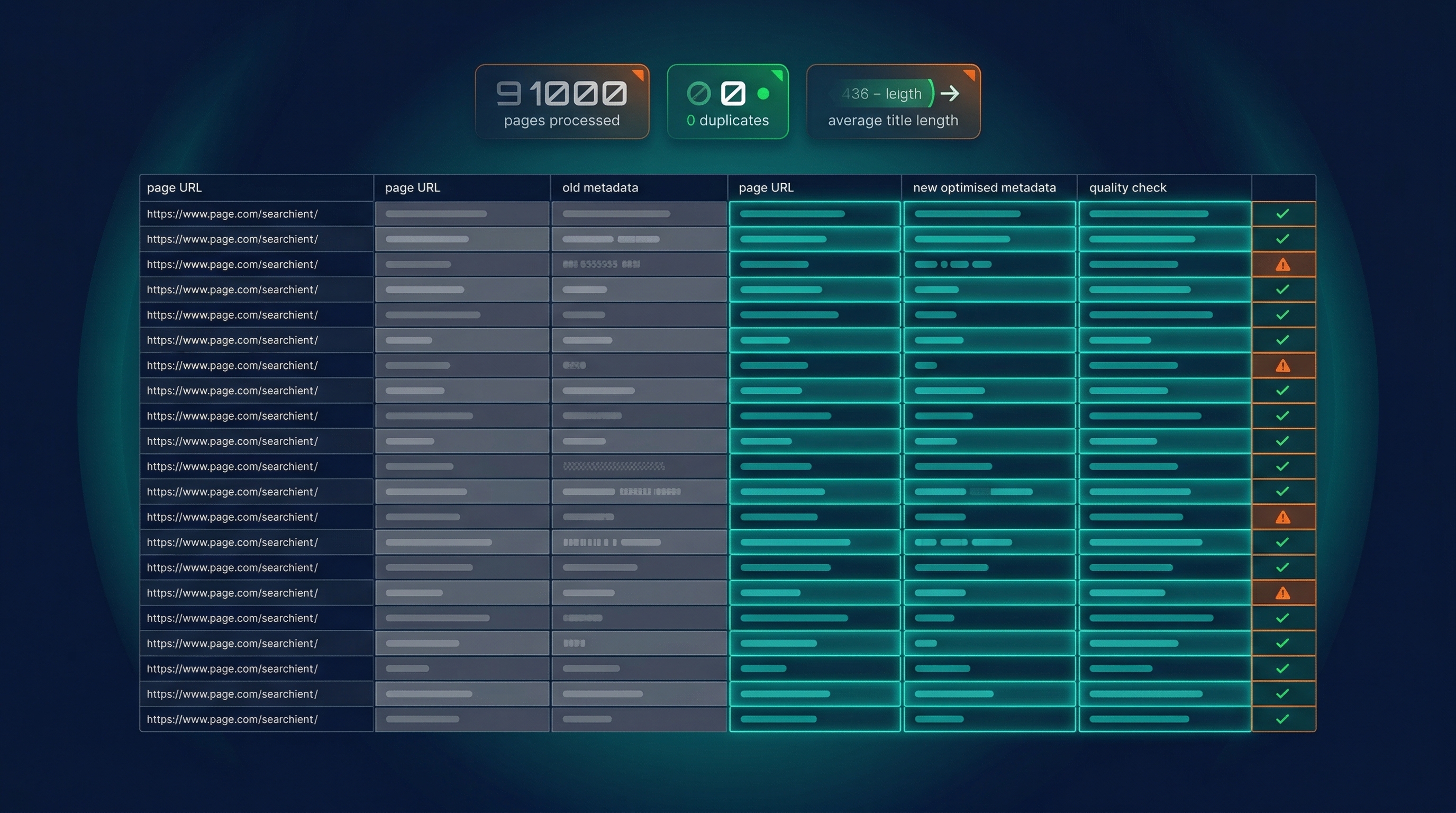
Import-Ready CSV
A spreadsheet with every URL mapped to its current title tag, meta description, and H1 alongside the new optimised versions. Columns are formatted for direct CMS import. No reformatting, no copy-pasting — upload and apply.
Individually Crafted Metadata Per Page
Each page receives a unique title tag (50–60 characters), meta description (150–160 characters), and H1 based on per-page analysis of product name, category, attributes, and competitor keyword data. Not a template applied across categories — individual analysis per URL.
Quality Assurance Report
Every batch is scanned for duplicate titles, length violations, missing keyword targets, and consistency issues. Edge cases that need manual review are flagged separately with specific recommendations. You spot-check 20–30 pages. If those are good, the system's consistency means the rest are too.
Implementation Notes
CMS-specific import instructions, any manual review recommendations, and a summary of improvements made — duplicates fixed, keyword targeting added, truncation issues resolved.
Three Ways to Work Together
Managed Service
Send URLs, Receive CSV
Send me your URLs or sitemap and any keyword priorities. I run the full pipeline — crawl, per-page analysis, metadata generation, quality check — and deliver the CSV within 24–48 hours. You review, import, and move on. No setup, no learning curve, no system access needed.
Best for: Agencies that want metadata done without adding it to anyone's workload.
Buy the System
Purchase and Run It Yourself
Get the automation pipeline installed in your own environment. Same per-page analysis, same quality checks, same CSV output — but you run it whenever you need it. Includes setup, documentation, and a walkthrough session.
Best for: Agencies with ongoing metadata needs across multiple clients who want to run it in-house.
Bespoke Build
Custom Requirements
Custom metadata fields, specific output formats, CMS integration, or additional analysis layers built to your requirements. If the standard pipeline does not fit your workflow, I build one that does.
Best for: Agencies with non-standard CMS platforms, custom metadata fields, or specific output requirements.
Who built this
Every system, every pipeline, every deliverable — built and maintained by one person.

Credentials
Experience
I built the metadata engine because I watched agencies spend weeks writing title tags that a system could analyse and generate better, faster, and more consistently. Every page gets individual analysis — product name, category, attributes, competitor keywords — before any metadata is written. 17 years of knowing what makes metadata rank, built into automation that doesn't cut corners on page 1,000.
Why this matters
- ✓ 17+ years hands-on SEO experience with automation systems built on Python and Claude API
- ✓ Processing thousands of pages per project with consistent output quality
- ✓ Every page individually analysed — product name, category hierarchy, attributes, competitor keywords — before any metadata is generated
- ✓ The system doesn't have bad days — page 1,000 gets the same analytical depth as page 1
How Bulk Meta Automation Works
Submit Your Pages
Send a sitemap URL, a list of URLs, or a CMS export. Add any keyword priorities or focus areas if you have them. Takes five minutes of your time.
Full Site Crawl
Every page is crawled to capture the current title tag, meta description, H1, content summary, category context, and internal linking structure. This is the baseline.
Per-Page Analysis
Each page is analysed individually. Product name, category hierarchy, attributes (colour, size, material), and competitor keyword data are identified. A target keyword is selected per page — not per category, per page.
Metadata Generation + Quality Check
Unique title tags, meta descriptions, and H1s are generated per page based on the analysis. Then every piece of metadata is scanned for duplicates, length violations, and missing keywords. Edge cases are flagged for manual review.
CSV Delivered
Within 24–48 hours, you receive the CSV with current versus new metadata for every page, plus implementation notes. Review it, import it, done.
How I Deliver This
The pipeline is built in Python with Claude API handling the per-page analysis and generation. Each page is processed individually — the system reads the crawled content, identifies product attributes and category context, checks competitor keyword data, selects a target keyword, and then generates metadata specific to that page. This is not a prompt template with variables swapped in. The analysis layer means each page's metadata reflects what is actually on that page. Automated QA scripts then scan the full batch for duplicates, length violations, and consistency issues before the CSV is generated. Works the same whether it is 50 pages or 5,000. Part of the SEO automation suite. Need ongoing metadata management? See automated reporting.
Frequently Asked Questions About Bulk Meta Automation
Will the metadata all sound the same?
No. Each page is analysed individually — a blue running shoe gets different metadata than a red hiking boot. The analysis examines product name, category, attributes, and competitor keywords per page. The output is unique because the input analysis is unique. Not a template.
How is this different from bulk meta tools I have used before?
Most tools use template patterns: "{keyword} — Buy {product} Online." This system analyses each page individually and crafts metadata based on per-page data. It is the difference between a mail merge and a copywriter who has read every product page.
What format is the deliverable?
A CSV spreadsheet with columns: URL, Current Title, New Title, Current Description, New Description, Current H1, New H1. Ready to import into most CMS platforms. I include implementation notes specific to your platform.
How long does it take?
24–48 hours from receiving your URLs, depending on page count. Up to 5,000 pages processed in under 48 hours.
How much does it cost?
Three tiers: £297 for up to 250 pages, £497 for up to 1,000 pages, £797 for up to 5,000 pages. Fixed price — no hourly charges, no scope creep, no surprises.
Can I review the metadata before importing?
Yes. You receive the full CSV to review. Spot-check as many rows as you want. The system is consistent — if 20 are good, the rest are too. Edge cases that need human review are flagged separately.
Do I own the metadata after delivery?
Yes. You own the CSV and all generated metadata completely. Import it into any CMS, share it with your client, use it however you want. No licensing, no ongoing fees, no restrictions.
Can I use this as a managed service for my clients?
Yes. The managed service is the default delivery mode. Send URLs, receive CSV, deliver to your client under your own brand. I include an optional agency column in the CSV for white-label delivery.
Ready to Get Your Metadata Done?
Send your URLs or sitemap and I will deliver unique, keyword-targeted metadata for every page within 24–48 hours. Fixed pricing from £297 for up to 250 pages. No templates, no hourly rates, no month-long timelines. Just per-page analysis, quality-checked output, and a CSV ready to import.
Still have questions? Book a 15-minute call — no obligation.