Automated Keyword Research
From 10,000 Keywords to a Publishable Strategy in Hours
The pain point isn't finding keywords — it's turning 10,000 keywords into a publishable structure. Most agencies drown in data. My automation clusters keywords by intent, maps them to content types, identifies competitor gaps, and generates implementation-ready content briefs.

Choose Your Audit
Prospect Audit
10-minute scan. Top 5 fixes. Branded single-page PDF you can pitch to any prospect.
Most PopularAI SEO Audit
40 checks, 12 categories, AI readiness scoring. Full branded PDF report.
Advanced Audit
Everything in AI Audit plus competitor gap analysis, content strategy, and implementation roadmap.
You're Drowning in Keywords But Starving for Strategy
Keyword research tools give you lists. Long lists. But a list of 10,000 keywords isn't a strategy. Someone has to cluster them by topic, analyse intent, map them to page types, check what competitors rank for, and decide what to prioritise. That takes a senior SEO days — per client.
Many agencies end up paying for three different subscriptions just to get a clear picture of rankings, competitor gaps, and search volumes. Even then, the output is raw data that needs human interpretation before it's actionable.
AI-driven keyword research automation handles the heavy lifting: intent analysis, topic clustering, competitor gap detection, and content brief generation. Your strategist reviews and refines — they don't spend days in spreadsheets.
What You Get
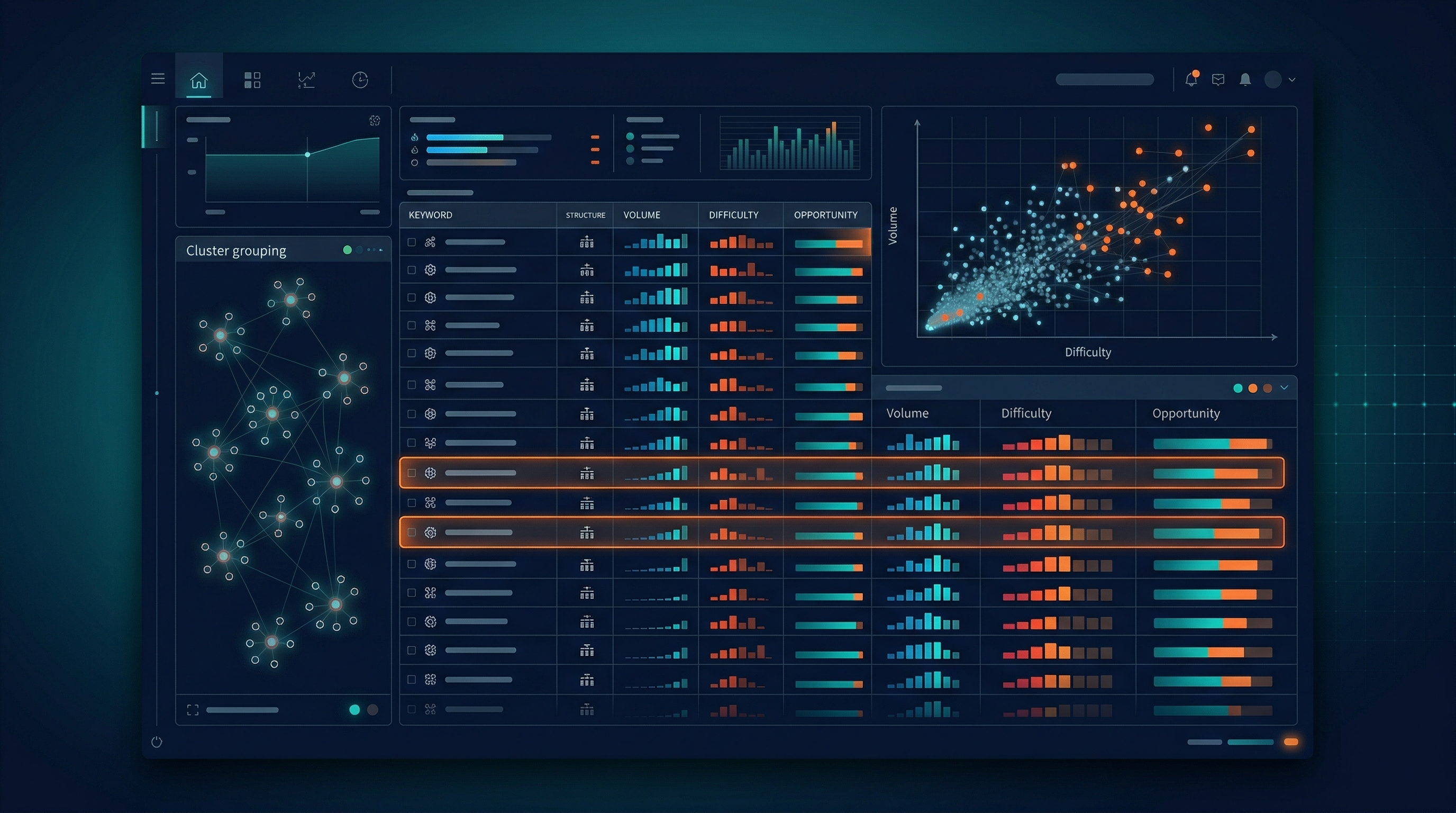
AI Topic Clustering
Automatically groups thousands of keywords into topically related clusters. Minutes, not days.
Intent Classification
Every keyword tagged with search intent — informational, commercial, transactional, navigational. Map content types to intent automatically.
Competitor Gap Analysis
Automated comparison against top competitors. Surfaces keywords they rank for that you don't — prioritised by volume and difficulty.
Content Brief Generation
Turns keyword clusters into structured content briefs — target keywords, headings, questions to answer, and word count targets.
Opportunity Scoring
Each keyword cluster scored by traffic potential, competition level, and relevance to the client's business.
SERP Feature Mapping
Identifies which keywords trigger featured snippets, People Also Ask, and other SERP features — so you can optimise for them.
How It Works
Seed Keyword Input
You provide seed keywords, competitor domains, or a topic area. The system expands from there.
Data Collection & Expansion
Automated scraping of SERP data, related keywords, People Also Ask, and competitor rankings.
Clustering & Intent Analysis
AI clusters keywords by topic and classifies intent. Human-level accuracy at machine speed.
Strategy Deliverable
Branded report with prioritised keyword clusters, content briefs, and implementation timeline.
Three Ways to Work Together
Managed — I Run It for You
I handle everything. Systems configured, maintained, and operated on your behalf. You receive the output. Predictable monthly cost, no hiring, no training.
Book a Call →Buy — Own the System
Purchase the automation system and run it in-house. Full documentation, training, and handover. One-time cost, full ownership, no lock-in.
Get a Quote →Bespoke — Built to Your Spec
Need something specific? I build custom systems to your exact requirements. Your specification, your workflow, your rules.
Discuss Requirements →Frequently Asked Questions
How many keywords can the system process?
There's no practical limit. I routinely process 50,000+ keyword datasets. Processing time scales linearly — larger datasets just take a bit longer.
Is the clustering actually accurate?
It uses semantic analysis, not just string matching. Keywords are grouped by meaning and intent, not just shared words. Accuracy typically exceeds what a junior SEO would produce manually.
Can I use my own data sources?
Yes. Feed in exports from Ahrefs, Semrush, Google Search Console, or any CSV. The system normalises and processes any keyword dataset.
How is this different from Semrush's keyword tools?
Semrush gives you raw data. I give you strategy. The output isn't another list — it's prioritised clusters mapped to content types with implementation-ready briefs.
How long does a full research project take?
Typically 2-5 working days from seed keywords to final deliverable, depending on scope and market complexity.
Can I white-label the output?
Yes. All deliverables carry your agency's branding.
Related Services
Ready to Automate?
Book a 15-minute call. I'll ask about your current workflow, recommend a starting point, and show you exactly what the system can do for your specific situation.
Still have questions? Get in touch